NO CITY LIKE NEW ORLEANS
by Leigh-Ann Jackson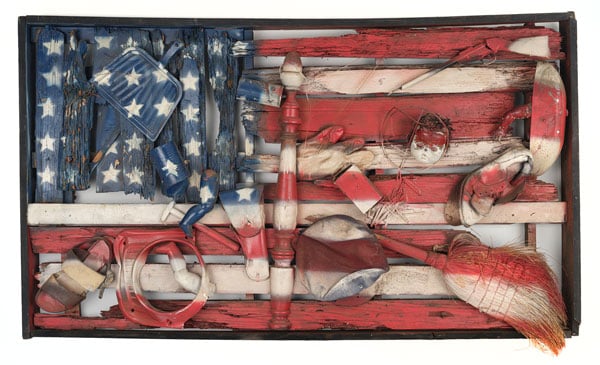
Willie Birch, Two Faces of a Nation, 1968. (Sesthasak Boonchai / Willie Birch Studio)
While following New Orleans artist Willie Birch on a walkthrough at the California African American Museum (CAAM), I wondered to myself whether any exhibition had ever been more aptly named.
Stories to Tell, the first-ever career retrospective of Birch’s works, spans nearly six decades and includes his abstract paintings from the early ‘70s, socio-political gouache paintings from the ‘80s, circa-‘90s papier-mâché sculptures, and more recent large-scale charcoal and acrylic works done on paper — works that collectively engage themes of social justice and Black Southern culture. As the sharply-dressed octogenarian strolled past his creations, he did indeed have many yarns to unravel.
Birch was born in New Orleans in 1942 and lived in various US and European cities over the course of his life before ultimately returning to his native city in 1994. During the preview, he waxed nostalgic about his days living in Baltimore (where he studied) and New York City (where he taught), scouring their streets for pieces of wood to carve for such works as the multimedia installation Voices from the Belly of the Earth (1979-82), which is on display near the entrance. Inspired by a creation myth of the Dogon people of Mali, it features wooden totems emerging from a mound of earth and ascending the walls.
 Evoking the Spirits of the Ancestors, 2002, is one of Birch's countless works on paper. (Sesthasak Boonchai / Willie Birch Studio)
The artist recalled a five-week trip to Egypt, where he developed a newfound appreciation for paper, which then became a favored medium. He schooled us on folkways carried over from West Africa, from Mami Wata (a water deity) to bottle trees (in which empty bottles are placed on the bare branches of trees, often as a form of spiritual protection). He spoke of encounters with contemporaries like multimedia artist David Hammons, Watts Towers Art Center co-founder Noah Purifoy, and Nuyorican artist Juan Sánchez. And he discussed his reverence for New Orleans’ assemblage yard art, before arguing that white artists like Jasper Johns and Robert Rauschenberg have unduly received credit for the “found objects” aesthetic. “Black people have always been innovative,” he noted, “have always brought something different to the table, whether it was recognized or not.”
Whoever scheduled the 20-minute press preview comically miscalculated. Birch ultimately held court for about an hour. And that’s a good thing, because it’s a gift to be able to hear from an elder statesman of African American art while he’s still thriving. (Get a sampling of his gift of gab from this Hammer Museum talk.)
But it’s hardly necessary to have the artist present in order to comprehend what his works convey. Take, for example, the life-size sculpture, Memories of the ‘60s (1992), of a gray-haired woman sewing a quilt that illustrates the divergent Civil Rights Movement strategies of Malcolm X and Martin Luther King Jr. The piece highlights the importance of documenting the nation’s history of racial strife, which is especially relevant now that such practices are falling out of favor.
Then there are the depictions of Black childhood in such sculptures as Bird Catcher (1991) and Uptown Memories (A Day in the Life of the Magnolia Project) (1995). These allude to the joy, curiosity, innocence, and potential that need to be nurtured in the younger generation. The poignant An American Family (1991) shows a mother and two children wearing clothes covered in phrases describing international violence. It is likely to activate your tear ducts.
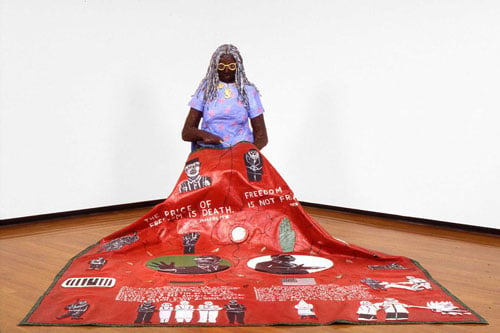
Memories of the '60s, 1992, engages civil rights history. (Sesthasak Boonchai / Willie Birch Studio)
Birch’s Seventh Ward series of drawings capture quotidian scenes from his beloved NOLA: porchside domino matches, musicians marching down city streets, backyard fences in various states of disrepair. Though the works are rendered in black, white, and gray — colors not stereotypically associated with that city — they’re still vibrant. What’s more, it almost feels like you can hear the images, whether it’s a blaring trombone, a portrait subject’s laugh, or the bam! of bones hitting a folding table. The scenes are quintessentially New Orleans.
“That is the birthplace of the history and the culture of all Americans. It still has all of the cultural manifestations that make us who we are,” he crowed, ever eager to praise his hometown. “New Orleans is known as the place of many tongues. That’s beautiful! Look at the way we dress — we’re clean, we’re dapper! I see why they call these folks ‘arrogant.’ We’re not arrogant, we just know who we are, ya hear me?”
The show is being co-presented by the American Federation of Arts and the New Orleans Museum of Art (with Russell Lord of the Norman Rockwell Museum serving as curator). Birch pointed out that CAAM was a natural fit because he had been a mentor of sorts to the museum’s executive director, Cameron Shaw, during her stint in New Orleans. He recalled Shaw’s frequent visits to his studio and a thoughtful essay she wrote about his work in Art in America in 2016. The retrospective is scheduled to open at the New Orleans Museum of Art in March 2027.
For now, Angelenos can get a crash course on the cultural impact New Orleans has had on the country, as told by a proud native son.
🎺🎷🎺
Willie Birch: Stories to Tell is on view at California African American Museum through Oct. 21st; caamuseum.org.
Leigh-Ann Jackson is an art and culture writer whose work has appeared in the Los Angeles Times and The New York Times.
standup/email(600x100).png?upscale=true&width=1200&upscale=true&name=email(600x100).png)


.png?upscale=true&width=1200&upscale=true&name=email(600x100).png)
.png?upscale=true&width=1200&upscale=true&name=email(600x74).png)