AT THE MOVIES
by Hannah Tishkoff
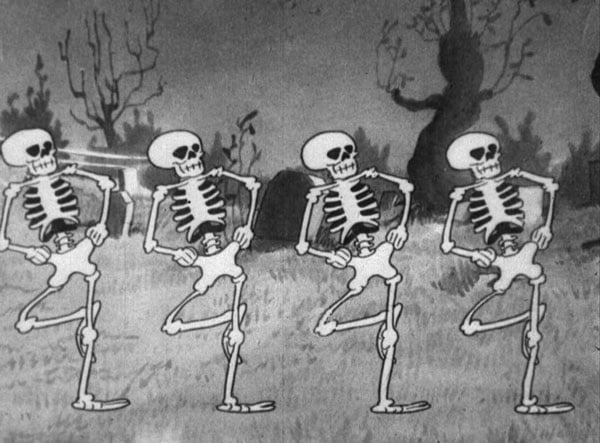
Walt Disney's The Skeleton Dance (1929) appears among contemporary works of video in
What a Wonderful Life. (Walt Disney)
“Magic, tragedy, drama.” These are the three words curator Udo Kittelmann used — outside, over a cigarette — to summarize What a Wonderful World: An Audiovisual Poem, a sprawling installation of video art and early cinema now open at the Variety Arts Theater in downtown Los Angeles. The phrase is broad enough to sound almost evasive, which may be fitting for an exhibition that unfolds across six levels, includes more than 40 works, and spans roughly 120 years of moving images. Rather than advancing a single argument, What a Wonderful World presents itself as an environment shaped by duration, sound bleed, and cavernous interiors, inviting viewers to wander at their own pace and make connections through proximity. The result is a compelling, if occasionally elusive, experience that privileges vibes over explanation.
Curated by Kittelmann, former director of Berlin’s Nationalgalerie, the exhibition marks the first US presentation of works from the Düsseldorf-based Julia Stoschek Foundation, a major collection dedicated to forms like video, performance, and multimedia environments. At the Variety, contemporary video art is placed “in conversation with early cinema,” pairing artists such as Marina Abramović, Doug Aitken, Ana Mendieta, Wu Tsang, and Arthur Jafa with historic figures, including the father of modern cinema Georges Méliès, the 1940s experimentalist Maya Deren, and Walt Disney.
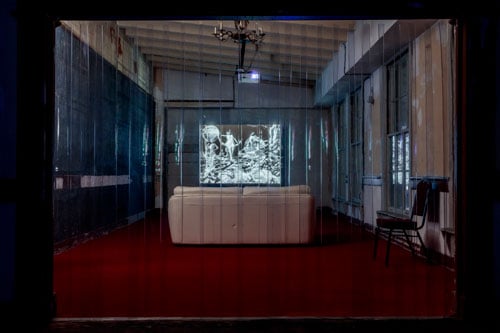
An installation view of Georges Méliès 1902 film, Le voyage dans la lune (A Trip to the Moon), at the Variety Arts Theater. (Joshua White / Julia Stoschek Foundation)
The logic of the exhibition unfolds slowly, but the choice of venue helps give it shape. The Variety Arts Theatre, which opened in 1924 with the beloved Talmadge Sisters and Cecil B. DeMille in attendance, was once part of downtown LA’s once dense network of movie palaces. Before becoming a cinema, it housed the Friday Morning Club, a women-led civic organization established in 1891 that played a central role in California’s suffrage movement.
Like many downtown theaters, it later cycled through periods of disuse as the city’s cultural gravity shifted. In a city where historic theaters often survive as facades (or reappear as pharmacies), the decision to return this site to moving images feels appropriate. Ornately designed in an Italian Renaissance Revival style, the space functions as a medium in itself, with its proportions, stairways, and acoustics shaping how works are encountered.
At the top of the building, on the fifth floor, Méliès’s A Trip to the Moon (1902) plays like a kind of origin story. With its painted sets, trick effects, and iconic image of a rocket lodged in the moon’s eye, the short film embodies an early vision of cinema as wonder, illusion, and theatrical spectacle. Seen here, in a former movie palace, it feels less like a historical artifact than a reminder of cinema’s original promise: to transport, astonish, and suspend ordinary time.

Arthur Jafa, APEX, 2013. (Arthur Jafa / Gavin Brown's Enterprise)
That sense of transport reappears on the first floor, in a very different register, in Jafa’s APEX (2013), a roughly eight-minute supercut of largely still images of Black artists, musicians, and athletes mixed with cartoons, illustrations, and scientific renderings of bugs. Jafa, a Los Angeles-based filmmaker long associated with the LA Rebellion, and known for compressing Black music, cinema, and violence into charged montage, demands a different kind of attention — rhythmic, cumulative, and emotionally insistent. Encountered within this environment, Jafa’s work sits in tension with early cinema as a counterforce insisting on the medium’s capacity to hold grief, beauty, and historical weight all at once.
Moving through the exhibition, the question becomes not what to watch, but how long to stay. Sounds overlap as a booming work in the building’s largest theater bleeds into pieces presented along hallways. Viewers can just as easily slip away into smaller screening rooms scattered throughout, some even furnished with velvet chairs. Partial viewing is not only permitted but built in, an acknowledgment of both human limits and contemporary habits of attention. In LA, a city shaped by film and television, that mode of viewing feels familiar. While What a Wonderful World includes figures central to that history, the city itself registers less as a lineage than as a condition. Encountering these works in a building designed for collective spectatorship briefly reasserts a form of looking that asks for presence rather than scroll.
 Jesper Just's Something to Love, from 2005, plays in a dilapidated room inside the old theater.
(Joshua White / Julia Stoschek Foundation)
The exhibition runs until midnight, and each night concludes with an unexpected coda: a screening of Miley Cyrus’s End of the World (Live from Chateau Marmont) at 11:45 p.m. The choice is telling. After hours of moving between art and cinema, history and experiment, the exhibition resolves in pop performance.
Rather than resisting disorientation, the exhibition embraces it. This is not confusion for its own sake, but a wager on attention, on the capacity of artists and viewers to remain present amid excess and contradiction. In LA, where cinema has always moved between experiment and spectacle, What a Wonderful World feels less like an argument than a gesture of faith: if you linger with the noise long enough, something human is bound to surface.
🎥🎥🎥
What a Wonderful World is on view at the Variety Arts Theater through March 20th, Wednesdays through Sundays from 5 pm to midnight, with additional talks, performances, and events throughout its run; jsf.la.
Hannah Tishkoff is an LA-based artist and writer whose work has appeared in Contemporary Art Review Los Angeles, Artillery, and Forever Magazine.
piefest/email(600x100).png?upscale=true&width=1200&upscale=true&name=email(600x100).png)