PAINT IT BLACK
by Sharon Mizota
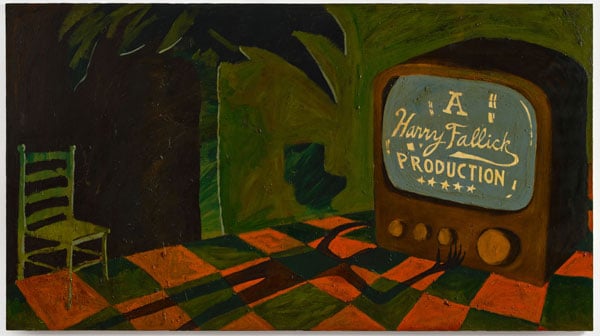
Wally Hedrick, A Harry Fallick Production, 1957.
(Paul Salveson / The Box and Parker Gallery)
You’d never know it now, but the art scene in California wasn’t always an international affair. While not quite a backwater, for much of the 20th century, it provided a haven for artists who did their own thing, far from the ideological and market centrifuge of New York City. Wally Hedrick was a quintessential product of this scene — restless, irreverent, rascally. His work, which ran from racy to befuddling to abject, is now on view in a joint retrospective at Parker Gallery and The Box, and it reminds us of the more open, experimental, and radical side of late 20th-century California art.
Wally Hedrick: Sex Politics Religion ranges from the mid-1940s to just before Hedrick’s death in 2003, and features 35 works in painting, sculpture, printmaking, and installation. Most are paintings, and boy, are they are all over the place: murky gestural abstractions that coalesce into images of genitalia and sex acts; supersized versions of old-timey advertisements for vegetables; surreal tableaux of oversized, abstracted body parts in creepy interiors or rural landscapes; more or less classic representations of the Virgin Mary and angels in ecstasy, and pseudo electrical diagrams that map gender relations and (again) sex. The works are peppered with ironic wordplay, euphoric eroticism, and an oddly romantic spirituality. Some have pointed political overtones, most prominently Hedrick’s all-black, anti-war paintings, which are particularly resonant now.
Born in 1928 in Pasadena, an art-curious Hedrick moved to San Francisco in 1947. There, he hung out mostly with the Beats: artists, writers, and musicians who rejected mainstream, capitalist norms to pursue liberation under the influence of Asian religions, sexual freedom, and psychedelic drugs. Friends and colleagues included literary figures Allen Ginsberg and Jack Spicer, and abstract painters Deborah Remington and David Simpson.
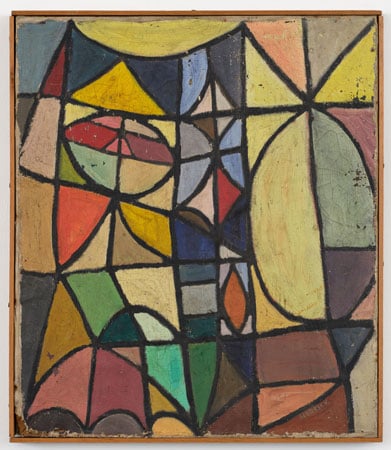
An early work by Hedrick titled The Cheesegrater, from 1946, is on view at The Box.
(Paul Salveson / The Box and Parker Gallery)
After serving in the Korean War, Hedrick returned to San Francisco and attended the California School of Fine Art (which became the now shuttered San Francisco Art Institute). In 1954, he cofounded the Six Gallery, a seedbed for the anarchic, minimally scripted performance art that became “happenings.” The gallery’s opening event involved blowtorching a piano; it was also the place where Ginsberg first read his signature poem Howl, seated on a toilet.
Although he never fully identified with the movement, Hedrick also ran with Bay Area Funk artists, and their expressionist approach to the figure and use of found objects meandered into his own work. In 1955, he had his first solo museum exhibition at the de Young Museum in San Francisco. Four years later, he was included in the influential group show, 16 Americans at New York’s Museum of Modern Art, alongside Robert Rauschenberg, Louise Nevelson, and other mid-century giants. His star was on the rise.
Then came the escalation of the U.S. war in Vietnam. In 1963, Hedrick decided to take a stand. “I would withdraw my services from almost everything…I was going to stop the war by not letting anybody see my work,” he recalled in a 1974 interview. In the wake of 16 Americans, he had interest from New York galleries but chose to walk away from the commercial art world altogether. “Like any American, I could use the money,” he said, “But on the other hand, I found that there's other ways of living.” Hedrick made ends meet running a small repair business, Wally’s Fix-it Shop. A weathered sign from the store hangs high overhead at The Box.

Wally's Fix-It Shop, 1971. (Paul Salveson / The Box and Parker Gallery)
He also continued to make art, some of which enacted radical refusal. War Room, at Parker Gallery, is an eleven-foot square enclosure made of stretched canvases that Hedrick first constructed in 1967 to protest the war in Vietnam. The paintings, each eleven-feet high, literally turn their backs on the viewer, exposing their stretcher bars. To see them, one climbs through a small door cut in the corner of one canvas; the inside is all solid black. But these are not the smooth, pristine surfaces of Minimalism or Color Field painting; they are obdurately ugly, scumbled, and bumpy, evocative of scabs or scars. By brusquely, furiously painting over whatever was there before, Hedrick performed a visual negation and a kind of burial. “I'm trying to make these paintings do what politicians should be doing,” he said in a 2002 interview. They’re as close as painting gets to screaming “No!”
The gesture is depressingly still relevant. Hedrick returned to making black paintings in the 1990s in response to the Gulf War, and reprised War Room in 2003 at the San Francisco International Art Fair following the U.S. invasion of Iraq. Now as the US bombs Iran and our government continues to support Israel’s genocide in Palestine — to say nothing of murdering its own citizens at home — the work feels like a necessary reminder, not only of how a previous generation resisted, but of the power of refusing to go on as usual, when “usual” means perpetual war. There are other ways of living, after all.
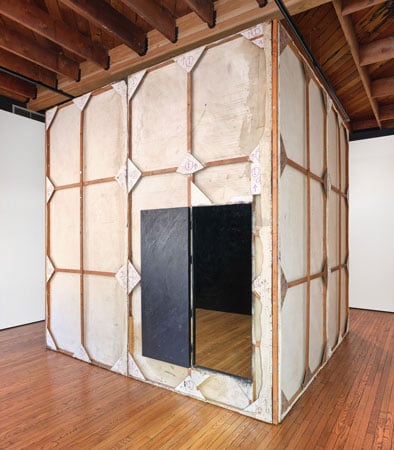
Hedrick's War Room, 1967/1968/1971/2002.
◼️◼️◼️
Wally Hedrick: Sex Politics Religion is on view at the Box and Parker Gallery through April 4th; theboxla.com and parkergallery.com.
Sharon Mizota is a critic, researcher, and archivist based in LA. Her work has appeared in the Los Angeles Times, Bomb, Hyperallergic, and KCET.
.png?upscale=true&width=1200&upscale=true&name=email(600x100).png)