In this newsletter:
- Feature: The next space station – straight outta Long Beach?
- FREE to attend — PieFest is coming up!
- Valley punk rockers will be sad to see the Midnight Hour Records go
- Monterey Park fights a data center
- Celebration, but also cautious optimism, in Tehrangeles
- Why does LA look so trashy?
- The radio program attuned to Altadena’s Black community
piefest/email(600x100).png?upscale=true&width=1200&upscale=true&name=email(600x100).png)
The next space station – straight outta Long Beach?
by Brandon R. Reynolds
I was standing in a space station the other day, as one does, entertaining a not-uncommon thought: Where do we go from here? Like, as a civilization. The answer to that can be pretty negative for a lot of reasons, but every now and then, I come down with a pretty severe case of optimism, and my visit to Vast, a local company that builds space stations, was one of those times.
The startup is one of a number of frankly sci-fi operations popping up in and around Long Beach, or as the city is billing itself, Space Beach. There are rocket startups, satellite operators, and even asteroid miners. Businesses looking for opportunities to expand the human race and, of course, to create new market opportunities.
Vast’s market opportunity is to fill a void. Or, well actually, to replace one of the few non-voids in the void of space: The International Space Station is nearing the end of its life, and NASA plans to decommission it in 2030. SpaceX has gotten a contract to deorbit it the following year… which is a nice way of saying crashing it into a remote part of the Pacific Ocean.
The space station I was in was a model for the real one, set to launch, if all goes to plan, by March of next year. If that works, and NASA funding comes through, Vast would send more of these modules into low-earth orbit over the next three to four years, connecting them like the sections of a hamster habitat. And then? Hopefully, the business will roll in.

In a model of the Haven-1 spacecraft, Vast CEO Max Haot points out a live-work space with great views and plenty of room for four astronauts to sleep in the walls.
Photo by Brandon R. Reynolds.
Vast is one of many participants in a new space race: not the 20th-century version where you go up, do stuff, and come back down (at great cost). Vast’s mission is part of a larger goal to create a whole new infrastructure in space — factories and laboratories intended to create things up there that can be sent down here, or even sent further out — to the moon and Mars and beyond.
Creating an industry up there saves on massive fuel costs, and the microgravity also opens up possibilities for innovation in biomedical research, pharmaceutical development, computing, and, of course, tourism. Whoever gets that space station up there first may become the hub for a future economy.
“So the first challenge to the new era of commercial space stations — not government-owned and -controlled — is to make it sustainable,” says Vast’s CEO Max Haot, “so that we can do as much activity, as much science, as much research, as much astronaut-training before we go to the moon and Mars, but in an economical, sustainable way.”
 Vast CEO Max Haot runs a company that has both an open-plan kitchen and (look closely) a mission control. Photo by Brandon R. Reynolds
Vast has competition: A Colorado company called Axiom Space plans to attach modules to the ISS that will then sort of bud off to become a new station.
Plus, there’s Orbital Reef, a project from Jeff Bezos’ Blue Origin and other companies. The idea there is inflatable modules, like a bouncy castle in the sky.
A company called Voyager Space is building what it’s calling Starlab. This one has backing from Airbus and Mitsubishi, with crew quarters designed by Hilton.
Into this game, here comes Vast. Funded by one man, a billionaire named Jed McCaleb, who made a fortune in cryptocurrency before creating Vast in 2021, and now, like Bezos and Musk before him, he’s set his sights on the stars.
The other companies have all gotten a bit of money from NASA, and Vast hasn’t, which makes it a bit of an underdog. Axiom is already sending astronauts to the ISS and planning to build its new station on the existing one. But Vast is moving quick: It launched a test version of its Haven-1 module last year and plans to be the first to officially have a commercial station in orbit next year.
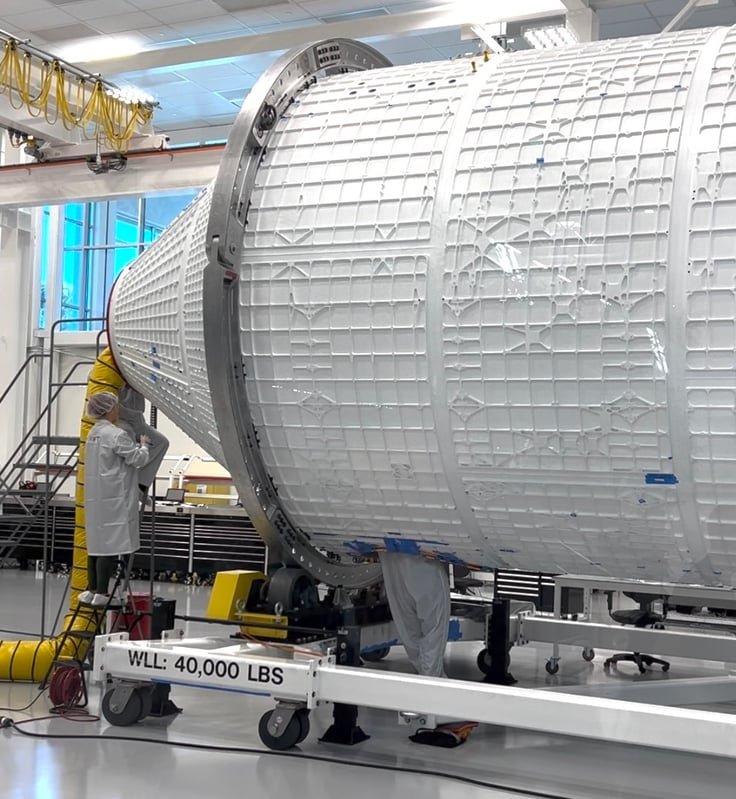
Technicians are assembling the real Haven-1 module, set to launch in 2027. Photo by Brandon R. Reynolds.
This is why I wonder, Where do we go from here? Right now, all these space startups are relying on the government, which is typically interested in defense against other nations, also putting all manner of things in space. Will all the taxpayer money poured into this benefit the rest of us? Is space just going to be the final frontier for tech bros? Or will this all really and truly be a paradigm shift for the human race?
There’s a lot that remains to be seen, but I can’t help but be excited. There’s that optimism, floating like an astronaut who’s come untethered, either to burn up in reentry or to finally bump up safely against one of these new outposts. Either way, the view from here is pretty impressive.

piefest/email(600x74).png?upscale=true&width=1200&upscale=true&name=email(600x74).png "email(600x74)")


