LOST IN THE NARRATIVE A view of the soon-to-debut Lucas Museum. (Hufton + Crow)
The first piece of art ever acquired by George Lucas was a page from the comic book Alley Oop, by V.T. Hamlin, about the adventures of the title character in a kingdom called Moo. Lucas says it cost him $30 and was his entry into collecting. The piece now hangs in his new museum in Exposition Park, which has been holding previews in advance of its public opening at the end of the month.
Needless to say, the curiosity levels for this project have been “high” since it was first announced that the Lucas Museum of Narrative Art would land in LA in 2017. Much of the speculation has been fueled by the spaceship-like form of the building (I have a review forthcoming in Bloomberg) and by the contours of Lucas’s somewhat self-invented category of “narrative art” — described as “art that tells a story.” Think: comic books, manga, illustration, photography, muralism, and figurative painting by artists such as Norman Rockwell and Maxfield Parrish.
So how does all of this hold up? Well, it’s a very mixed bag.
The building has its delightful moments, and the views are terrific. (For more, see dispatches by KCRW’s Frances Anderton and LA Times contributor Sam Lubell.) And Lucas’s collection no doubt includes some remarkable works — including paintings by early 20th century regionalist Thomas Hart Benton, the Mexican muralist José González Camarena, and a gallery devoted to Japanese manga that includes an original drawing by Osamu Tezuka, the creator of Astro Boy.
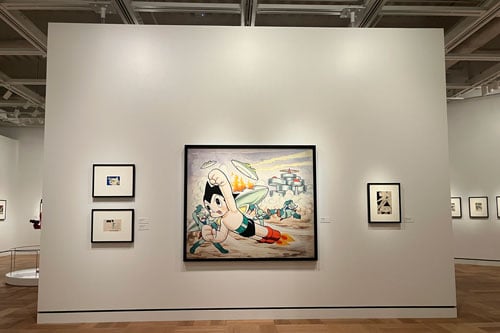
Entering the "Manga" gallery, you'll find Koide Shinkosha's large watercolor of Astro Boy from 1963.
(Carolina A. Miranda)
But there are doozies, including middling fan art and a bronze Indiana Jones, who looks like he got lost in one of the museum’s passageways. More significantly, the groupings of the works are wildly befuddling. A gallery titled “Community,” for example, features both a self-portrait by Frida Kahlo and an 1894 canvas by Cassius Marcellus Coolidge showing dogs playing cards. (I’d love to be a fly on the wall when someone from Mexico’s culture ministry shows up for a visit.)
I am all for examining popular culture. (I got my start as an art writer by photographing graffiti.) But after spending five hours scrutinizing 100,000 square feet of galleries over two floors, my conclusion is that the Lucas is a massive missed opportunity.
As many critics have noted over the past few days, the collections are presented with little in the way of context. (See write-ups by Matt Stromberg and Maximiliano Durón.) Wall labels include only the name of the artist, the work, and its materials. You can scan artworks using your phone to receive a few additional details, but this is more irritating than revelatory (and will limit access to those without smartphones, especially children). There is little information for why certain works have been grouped together or what forces might have shaped their aesthetics. Lucas’s idea, I presume, is that by limiting the curator-speak, visitors can marinate in the universality of his art.
 Cassius Marcellus Coolidge's A Pat Hand, (1894) helped launch the genre of kitschy paintings showing dogs playing poker. (Lucas Museum of Narrative Art)
The problem is that narratives have a way of cropping up — whether stated or not. I entered the collection through the Fantasy section, which features work by famed sci-fi illustrators like Frank Frazetta and Sanjulián (born Manuel Pérez Clemente), where I saw paintings drawn from tales like Conan the Barbarian and Vampirella. I then moved on to the Romance gallery, where a large painting by the kitsch Mexican painter Jesús Helguera shows a pirate carrying a woman in a grass skirt. This was followed by the Adventure section, which contained an illustration by Bruce Minney, known for his work in men’s adventure magazines in the 1960s and ‘70s. His painting, P.O.W. Assassins (1975), shows a square-jawed man punching a Nazi as a startled woman gets out of the way.
You can tease out some broad themes about the heroic and good versus evil in this eclectic mishmash of works. But on the whole, it’s a lot of cheesecake. Men are depicted as muscled and strong; the women as helpless and scantily clad. Elsewhere, a gallery devoted to “Motherhood” showed numerous paintings of women cradling infants. (There was no such gallery devoted to fatherhood.) The view of womanhood that this purportedly convention-busting institution is presenting is often quite retrograde: sexpot or mother. By the time I made it to a display of work by turn-of-the- 20th century American illustrator N.C. Wyeth, I was relieved to find a fully clothed woman holding a book. (Langford of the Three Bars, from 1907, in case you’re wondering.)
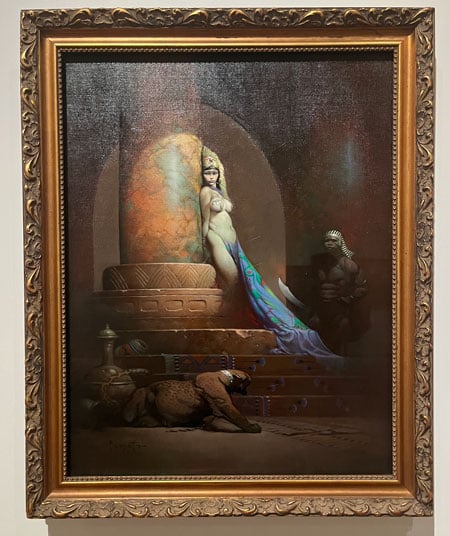
Frank Frazetta, Egyptian Queen (1969). (Carolina A. Miranda)
In the right curatorial hands, these works could have told a much richer story. I was struck by how so much of the work in the Fantasy section, for example, borrowed from Orientalist art, a 19th century form with roots in Europe that exoticized Middle Eastern culture and frequently depicted women in eroticized harem scenes. The Lucas contains an Orientalist painting by Frederick Arthur Bridgman, The Procession of the Sacred Bull Apis (1879), showing a ritual drawn from Egyptian antiquity, with women in sexy garb. It would have been interesting to explore the genre’s troublesome stereotypes and how it lives on in the realm of sci-fi, but there is no such probing — neither on the museum’s walls or in the digital guide.
Over the years, Lucas has said that part of the reason he began collecting such work was to help preserve forms of popular art that have “always been thrown in the garbage.” That may have been the case when he first started collecting, but no longer. Underground comic artist R. Crumb is now represented by a blue chip gallery. And, for decades, museum exhibitions have explored artistic genres such as comic books and manga in insightful ways. Currently, the Skirball Cultural Center has a fascinating show about how comics have reflected and shaped national identity.
But that doesn’t fit Lucas’s most prominent narrative — about one man on a hero’s journey to save popular forms from the pretentious gatekeepers of fine art.
🎨🎨🎨
The Lucas Museum of Narrative Art opens to the public on September 22nd; lucasmuseum.org.
More Like This:
Having trouble landing tickets for the Lucas? Check out Inventing America: The Comic Book Revolution at the Skirball Cultural Center, which features a century’s worth of smartly contextualized comic art that looks at how the form connected to defining events such as World War II, the Cold War, and various civil rights movements, among other themes. Through February 28; skirball.org.