The Future is Here
by Paula Mejía
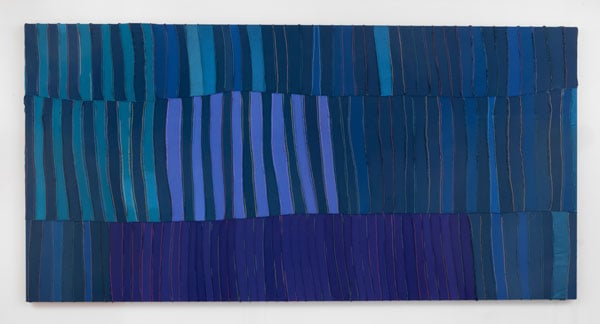
Anthony Akinbola's Blue Train (2024) is crafted from dozens of durags. (Anthony Akinbola / Night Gallery)
The future has never been promised, as the oft-repeated saying goes. But trying to make sense of what the years ahead might hold feels especially tenuous right now. Lately I find myself feeling wrung dry from responding to, well, everything happening so relentlessly in the present — I mean, thinking about the future? In our political climate? In this economy??
The thing about gut-churning uncertainty, though, is that it inevitably gives way to different ways of thinking. That’s especially true of abstraction, a movement that’s all about tinkering with traditional methods of art-making and, by association, our grasp on reality. All of this is to say that the expansive new group show The Abstract Future, now on view at Jeffrey Deitch in Hollywood, couldn’t have arrived at a more apt time.
Curated by the gallery’s managing director Alia Dahl, the exhibition collates an international array of artists who employ familiar mediums — like painting, photography, and sculpture — to forge idiosyncratic abstract works capable of rearranging the brain. This show is a beast, spanning 64 total works and sprawling across Deitch’s two standalone galleries.
The pieces, while not always in conversation with one another, nonetheless coexist in a sort of uneasy harmony. LA sculptor Brian Rochefort’s three bulbous ceramic vases, oozing with glass fragments, sat nearby a staggering, rawhide-and-dirt piece by the Bay Area’s Rindon Johnson, that practically threatened to swoop in on unsuspecting gallery-goers from above like a bird of prey. Bronwyn Katz’s assemblage, crafted from salvaged bedsprings, pot scourers, and wires, resembled a particle from a certain pandemic we’re all still processing, while the gentle whimsy of Guillaume Dénervaud’s tempera and oil work nearby recalled the mystical abstractions of Hilma af Klint, the late Swedish painter. In the smaller gallery, Allana Clarke used hair bond glue as a clumped paint on linen to meditate on the toxicity of products meant for everyday use.
-B.jpg?upscale=true&width=1000&upscale=true&name=03-Rindon-Johnson%2c-View-out-the-slender-window...%2c-2019-(RJ-19.004)-B.jpg)
Rindon Johnson, View out the slender window: There’s always a hair in the soup somewhere and some people are looking with a magnifying glass, 2019. (Rindon Johnson / Jeffrey Deitch, Los Angeles)
These varied works both hewed to abstract disciplines and subverted them completely, often touching on themes including environmental hazards, the shifting goalposts of beauty standards, industrialization, and even extraterrestrial life. Mainlining it at once felt thrilling and, frankly, a little overwhelming. But it’s a good reminder, too: These discomfiting feelings are usually a precursor to growth.
There’s a lot to see in this massive show. Here are the ideas that stuck with me:
AN UNSETTLING PLAYFULNESS
Three folding sheet music stands are splayed open. Made by the New York City-based Kayode Ojo, the familiar pieces that accompany classical music and jazz concerts don’t hold music but are rather festooned with the sort of aesthetic flourishes a grand diva might don to further dazzle onstage — glittering rhinestones culled from a handbag and a baroque chandelier bib necklace. But peer more closely and you might be hit with a sinking feeling: toy metal handcuffs are interspersed amid the sparkle, becoming a riff on the murkier underbelly of show business, and the ways that even a deep passion for something can become a snare.
This sense of unsettling playfulness is sprinkled all over The Abstract Future, especially in the Berlin-based provocateur Raphaela Vogel’s queasy-looking patinated bronze sculptures. These spindly, four-legged pieces resemble dogs in theory, but their exposed vertebrae suggest something more sinister. Looking at these sculptures inspired something visceral — disgust mixed with awe. Perhaps it’s possible to bark and bite.

Kayode Ojo, Zoe, 2023. (Kayode Ojo / Sweetwater, Berlin)
BREAKING ART'S RULES
Silver-gelatin paper, the most common photographic medium, is a demanding material, one whose entire visibility hinges on whether or not it has been carefully guarded from errant streams of light. New York City-based artist Antonia Kuo created a seismic chemical painting that only works because of the unique way she exposed it to light, not in spite of it. Although the medium is typically used for analog printing in black and white tones, Kuo manipulates it in a way that she’s able to “coax colors from the paper,” as she once said. Kuo’s resulting painting, Twilight Child, is therefore stupefying, an explosion of pattern and drippy colors that might lead you into rabbit holes about how this chemistry-defying technique is possible.
Likewise, the Venezuelan artist Loriel Beltrán produced two hypnotic wood-paneled pieces for the show by doing something that’s perhaps even more frowned-upon in the art world than exposing film to light: He never cleans his mixing palette. Beltrán, who used to have a more straight-ahead painting approach, found that by letting the latex paint layer itself over and over again, becoming banded and almost cakey, it made for uniquely textural works that also served as an unsuspecting archive. “I liked,” he has said, “that it became this register for every painting that I had made in this palette.”

A detail of Loriel Beltrán's Hanging Figure, 2023. (Loriel Beltrán / CENTRAL FINE)
Beltrán’s insight is a good metaphor for the entire show: By turning the way things have always been done on its head, upending historical conceptions of how even abstract works have always been made, we can carve out new histories — perhaps even ones that can guide us into the future.
🎨🎨🎨
The Abstract Future is on view at Jeffrey Deitch through Aug. 2nd; deitch.com.

%2c-2023.jpg?upscale=true&width=1200&upscale=true&name=02-Bronwyn-Katz-Karutsib-amiros-(vaalbos-star)%2c-2023.jpg "A sculpture by Bronwyn Katz shows dozens of looping wire coils covered in gauzy white mesh, resembling some strange underwater plant.")

@2x.png?upscale=true&width=1200&upscale=true&name=email(600x100)@2x.png "A banner ad reads: \"KCRW's Mission Critical Fundraiser. The future is uncertain. You have the power to protect KCRW!\"")