LONESOME GUN
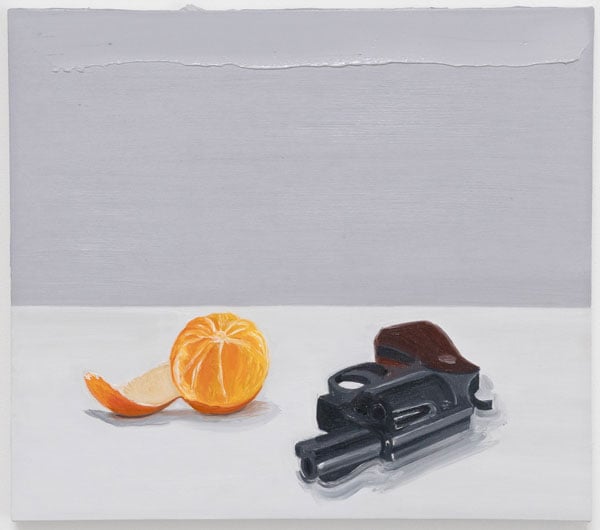
Salomón Huerta, Untitled, 2025. (Paul Salveson / Marc Selwyn Fine Arts)
Introduce a gun in the first act of a play, and it should go off by the third. That’s a very crude way of articulating the narrative principle of Chekhov’s Gun, inspired by the Russian playwright, who once advised a fellow writer to keep his narratives lean. His exact words: “One must not put a loaded rifle on the stage if no one is thinking of firing it.”
I couldn’t help but think of Chekhov’s Gun while absorbing Salomón Huerta’s remarkable solo show at Marc Selwyn Fine Arts in Beverly Hills, which, quite literally, brings the gun into the room — and then leaves it there for the viewer to ponder. Unspoken Ritual, as the show is titled, is in its final week at Selwyn’s Camden Annex location, and features almost a dozen enigmatic still lifes that each depict fruit or some other foodstuff alongside an old .38.
These are not sensational paintings. They do not celebrate guns or violence. Instead, Huerta has created taut scenes set against muted backgrounds, showing, for example, a luscious sliced plum next to the gun on a plain white surface. The gun’s barrel is angled towards the viewer; its owner and purpose, a mystery.
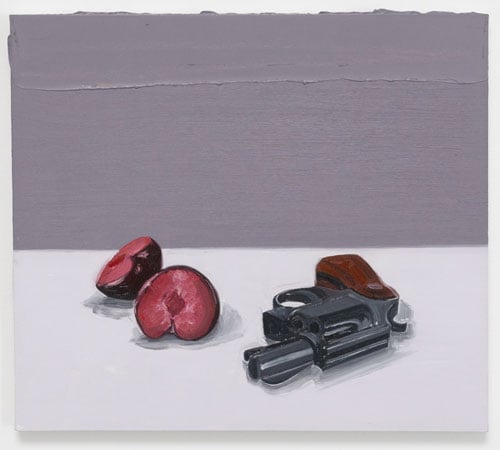
Untitled, 2025. (Paul Salveson / Marc Selwyn Fine Arts)
The paintings, interestingly, were inspired by events from the artist’s childhood. Huerta, 60, was born in Tijuana and raised in Los Angeles, where his family lived in the Ramona Gardens public housing project in Boyle Heights — during a particularly intense wave of violence. (A 1984 report in the Los Angeles Times described an open drug market in a parking lot known as “The Square,” where customers from as far away as San Diego would arrive to score PCP.) For protection, Huerta’s father carried the revolver. “He flashed it at people in the projects,” recalls the artist, “to let them know that we were not the family to play with.”
When his father was home, the gun would rest on his night table. Huerta recalls that he would often be enlisted to take his father a snack — perhaps an apricot or a sandwich — which he would gingerly place next to the firearm. “I didn’t care for it,” says Huerta of the gun. “I wanted to paint it as quietly as possible. It was this quiet object I knew not to play with.”
Huerta first rose to prominence in the 1990s for other equally enigmatic works — a series of figurative paintings that depicted the backs of his sitters’ heads, one of which can be found in MOCA’s permanent collection. (“It was another way of looking at a portrait,” he explains.) When he began the gun series in 2012, he was looking for a way to express the strange juxtapositions he had seen on his father’s nightstand. He studied still lifes by painters like Cezanne, Matisse, and Manet, but he found his greatest inspiration in the works of the Italian Giorgio Morandi, who was known for his tidy compositions of vases, bowls, and geometric forms rendered in neutral colors. Says Huerta: “They have this beautiful, dead quiet quality to them.”
That serene tone is what gives Huerta’s paintings their curious magnetism. He neither celebrates the gun nor condemns it — he simply places it before us to observe, to consider its form and its applications. The food offers contrast and contradiction: a lethal weapon next to provisions that offer sustenance. In one canvas, the gun lies next to a wholesome glass of milk. Life and death.
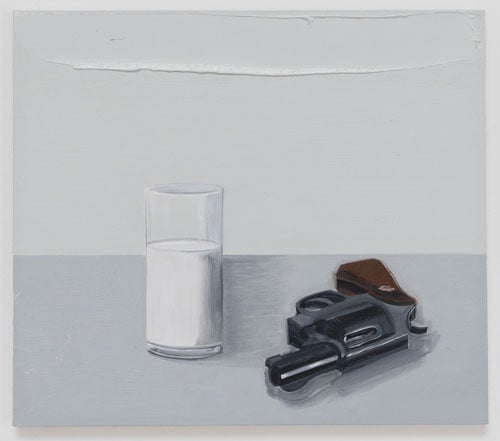
Huerta's still lifes feature food and drink the artist served his father. (Paul Salveson / Marc Selwyn Fine Arts)
For Huerta, who studied at Art Center College of Design and UCLA, this exhibition marks a comeback of sorts. In January, he and his wife, Ana Morales-Huerta (who is also a painter), lost their Altadena home in the Eaton Fire. His studio, located in Westwood, remained untouched. But his archives, as well as his collection of books and works by other artists, were lost to the flames. “One day everything is there and the next day everything is gone,” says Huerta. “It’s surreal. It’s hard to put another word to it.”
Since then, he has thrown himself into his work. In May, he had a solo show at Harper’s in New York City, where he displayed paintings from other series devoted to swimming pools and domestic architecture. The show at Marc Selwyn brings him back to LA — and back to his father.
“When my dad passed away, all his belongings were in a suitcase,” he says. “Besides his belt and his hat, the gun was the only thing he left behind. He was very minimal.” He was also quite taciturn. “There was no talking,” adds Huerta. “During the 35 years I knew my dad, we only had one conversation.” The paintings capture this spirit — simple scenes that nonetheless communicate with quiet force.
🍊🍊🍊
Salomón Huerta, Unspoken Ritual, is on view at Marc Selwyn Fine Art’s Camden Annex, through December 23rd; marcselwynfineart.com.
Note: Parking is at a premium in this corner of Beverly Hills during December. Public transit or rideshare is best.
_iphone17.png?upscale=true&width=1200&upscale=true&name=email(600x74)_iphone17.png)


.png?upscale=true&width=1200&upscale=true&name=LAbanner(600x100).png)

.png?upscale=true&width=1200&upscale=true&name=LAbanner(600x74).png)