THE LAND REMEMBERS
by Catherine G. Wagley
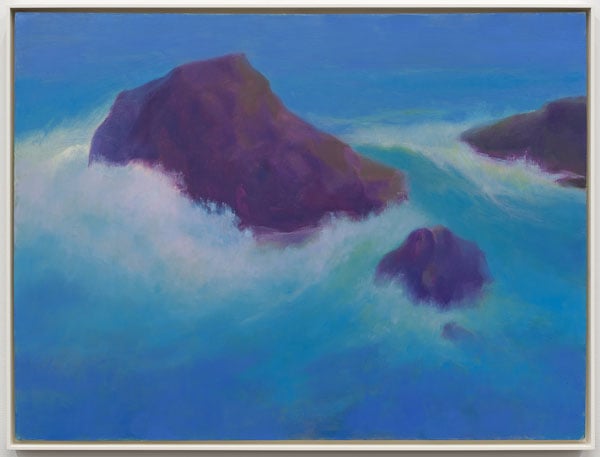
Richard Mayhew, West Bay, 2004. (Estate of Richard Mayhew / Karma)
There were already 19 artists on stage at the Art Students League on a chilly spring night in New York. Then painter Richard Mayhew invited one more, a man who’d been heckling them from the crowd. “Come on up here, brother,” Mayhew later recounted saying. When the man said his name was God, the panelists realized he was high out of his mind. No matter. It was good, Mayhew thought, to have “someone outside of the loop” represented, since this group of Black artists had convened to shift perspectives on the prejudices that limited their field.
It was 1971, and a number of them — Mayhew included — had just withdrawn from the Whitney Museum’s Contemporary Black Artists in America show, which had no Black curators. (The white curator, Robert Doty, couldn’t even be bothered to talk to painter Vivian Browne when he visited her studio). Painter Benny Andrews, a founding member of the artist-activist group Black Emergency Cultural Coalition, was there alongside sculptor Melvin Edwards, and painters Faith Ringgold and Louise Parks, as well as Browne. Together, they tackled confounding questions around representation — not even women-run galleries in New York showed female artists — and the poverty so many of them faced.
Mayhew was always bringing people together in wide-open ways, engaging in a kind of activism that doubled as world-building. Yet his own paintings were consistently informed by the landscape, though he called them “mindscapes,” because he worked from memory and imagination, not observation. A selection of work by the late artist (Mayhew died in 2024 at 100) features in Understory at Karma gallery in West Hollywood, organized by curator Mia Matthias, the artist’s first solo exhibition in LA since 1994. The brooding, earth-toned paintings he made in the 1960s, in which trees look like gothic ghosts, hang alongside the bright, blood-red near-abstractions he made in the 1970s, where a vague horizon line is the only realism, and his more pastoral scenes from the 1980s, including the deep and dense forest of Yesterday (1982).
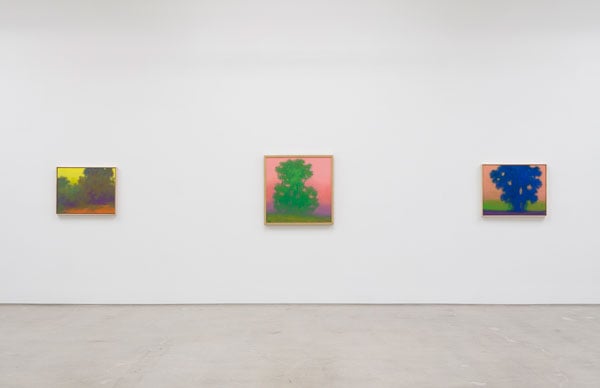
An installation view of Mayhew's landscapes at Karma. (Estate of Richard Mayhew / Karma)
New York Times critic John Canady, who labeled Mayhew a “nature poet,” claimed in 1971 that he could not be “called a black artist except by race,” spuriously implying that his paintings did not look Black. But to Mayhew, who also had Shinnecock and Cherokee-Lumbee ancestry, the landscape had everything to do with his identity. “In terms of Afro-American and Native American, their blood is in the soil of the United States,” Mayhew said in 2021, recalling a visit to a former plantation in Georgia, where he saw a bushy, shadowy terrain. “I wonder what happened in that area down there — how the slaves were being treated?” he asked himself, painting the area “based on just a feeling.”
Born on Long Island, Mayhew dabbled in jazz singing and served in the US Marines during World War II. (He later received a Congressional Medal of Honor, though he didn’t want much to do with mankind’s lust for “killing himself.”) In 1947, he enrolled in the Brooklyn Museum Art School. There, he absorbed everything painter Edwin Dickinson, whose landscapes possessed an impressionistic eeriness, could teach him. He worked odd jobs while studying, including painting ceramic plates alongside the artist Dorothy Zuccarini, whom he married in 1951. (“She so contributed to making Rick Mayhew the artist he became,” wrote their daughter Ina Mayhew, in a touching preface to her father’s oral history, in which Mayhew, so generous with other collaborators, refers to his first wife’s contributions as “secretarial.”) By 1963, he was teaching art at the Brooklyn Museum and the Pratt Institute, when a new friend, painter and conservator Felrath Hines, invited him to join a collective called Spiral.
Artists Romare Bearden, Charles Alston, Norman Lewis, and Hale Woodruff — all in their 50s and 60s — had tried to get an artist delegation together for the March on Washington, but by the time they’d assembled an intergenerational group (including 26-year-old painter Emma Amos), it was too late to organize a trip to DC. They kept meeting nonetheless, naming themselves after the Archimedean spiral (which constantly moves outward), and learning from each other as they plotted ways to change the New York art world. “They all had such completely different styles and they didn't even necessarily all get along, but then could go and … protest a show together,” says Matthias. “It’s that kind of productive friction.”
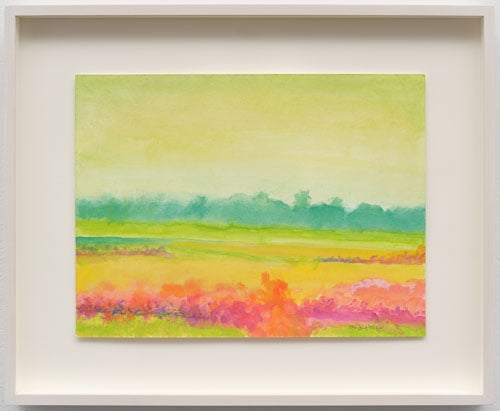
Untitled, 1992. (Estate of Richard Mayhew / Karma)
Mayhew took Spiral’s anti-individualist mindset with him in the mid-1970s, when he moved to California to teach at Sonoma State, where he invited dancers making a racket next door to just come dance in his classroom. Later at San Jose State, he co-founded an innovative art and science think-tank (they’d meet on a boat made of wire mesh and cement and dream about art and oceanography), then took a tenure-track position at Penn State, where he remained until he retired in 1991. He moved back to California, where he met his second wife, Rosemary Gibbons, and ultimately settled in Soquel, near Santa Cruz.
In Soquel, he missed the debate-driven community that had fueled him in earlier eras, but he found something else: a different, vibrant kind of color that came to define his later work. A glowing, almost ethereal purple appears in some of the paintings on view at Karma. It floats above orange and green hills and a pool of blue in Seascape (2009). It hovers behind a shamrock green tree, beneath undulating pink in an untitled painting from 2021. Maybe it was the ocean, maybe the sunsets, or maybe it was something happening inside his head, the “mood space” he once talked about.
🌳🌳🌳
Richard Mayhew, Understory, is on view at Karma through May 30th; karmakarma.org.
Catherine G. Wagley is an art writer based in LA. Her work has appeared in Momus, CARLA, and The New York Times.
.png?upscale=true&width=1200&upscale=true&name=email(600x100).png)