|
|
|
|
|
|
|
Dear DnA Readers,
I hope you are doing well and enjoying the distractions from all that ails us, provided by fab Bad Bunny, "quadg0d" Ilia Malinin, and the other sunny talents on the slopes and ice in Italy.
I just returned from the cold myself (hence this delayed newsletter) — seeing mom and other family and friends in the UK — and, like the Olympians, was constantly barraged with questions about Europe’s faithless boyfriend USA (and the diabolical Epstein and Maxwell, whose email revelations are causing heads to fall in Westminster). But I also got to go check out what’s been going on in design and architecture across London.
That included heading to the East End to visit the Stratford area that has been redeveloped as part of the 2012 Olympics legacy planning, with new transit, housing, public sports venues, a massive and packed Westfield shopping mall, a cleaned-up stretch of river, and a buzzy new cultural venue, the V&A East Storehouse.
There is much to be said about London’s approach to an Olympics legacy compared to LA’s. For now, let’s stick to the Storehouse, which in itself is quite a provocation.
 Inside the Storehouse atrium; image courtesy DS+R Inside the Storehouse atrium; image courtesy DS+R
The (V&A) Victoria and Albert Museum, founded in 1852, was essentially the world’s first design museum, now possessing around 2.8 million exemplars of fashion, textiles, furniture, metalwork, ceramics, glass, architecture, product design, and more. Needing some extra storage, leaders decided to house more than 250,000 objects and 1,000 archives in a four-story, 170,000+ square feet space carved into part of the former Olympics Media Centre in Stratford.
The concept was that this would be a “working museum building — a logistics centre for our collections and archives — and, uniquely, also a large-scale self-guided cultural experience," with "some of the characteristics and browsability of the Ikea shopping experience,” Tim Reeve, the museum's deputy director and COO told The Art Newspaper. They tapped Diller Scofidio + Renfro, architects of LA's Broad Museum, to design it.
The Storehouse opened last May to mostly stellar reviews about its radical take on the museum experience. Since then, I've been pondering whether the place is just that, or a problematic shrine to storage. DS+R principal Elizabeth Diller will give the keynote at Palm Springs Modernism Week this Saturday (see Design Things To Do below). Hopefully, she will talk about it.
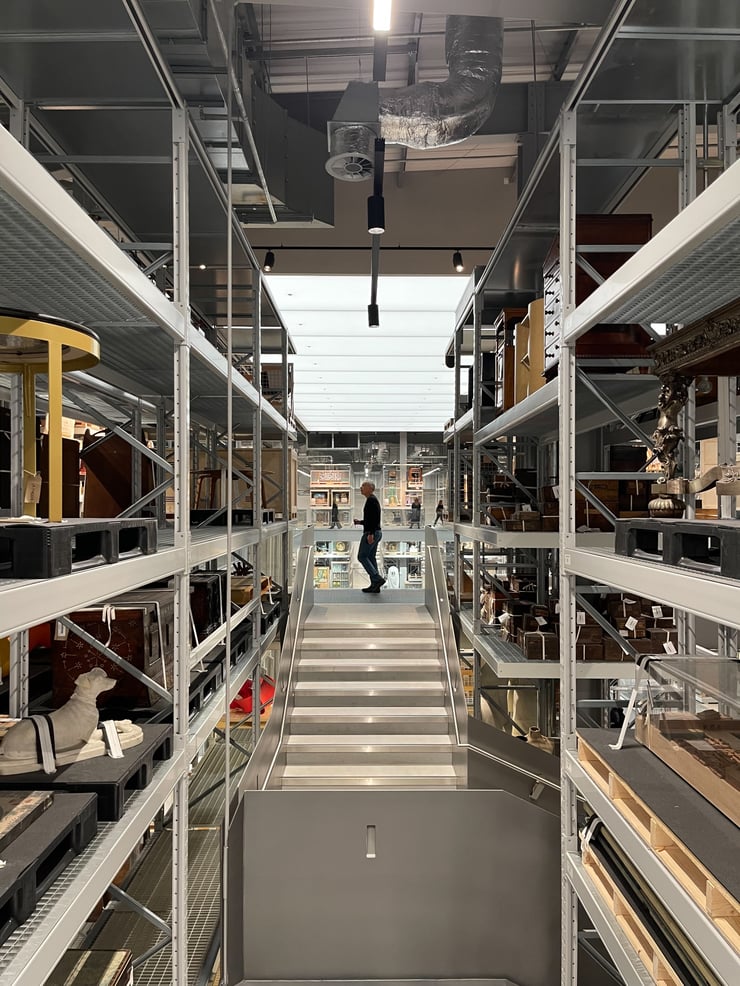
Views through the stairways and decks of V&A Storehouse East; photo by Frances Anderton
Anyway, to give you an idea of the experience, imagine a mix of the viewable archives that you can glimpse from the stairway at The Broad Museum, the transhistorical approach to curation that is expected at the new LACMA, and Ikea.
The Storehouse consists of thousands of rotating artifacts posed not on plinths within glass cases with scholarly texts. Instead, they are strapped naked onto pallets on open floors that surround a giant atrium space. Objects are arranged in seemingly unrelated juxtapositions — “Busts of emperors alongside armoires, a PJ Harvey, hollow body guitar alongside 15th century Turkish swords for disemboweling your enemy on the battlefield,” noted hubby Robin Bennett Stein. They are unlabelled, though a Qwerty code links to substantive information (it’s not clear what people without smartphones are supposed to do).
The space is industrial glam, with a hard-edged sheen from metal staircases and glass floors. It works wonderfully as a stage-set in which everyone is a player. Part of the fun is simply watching people move through the space. For researchers with specific objects in mind, they can arrange to view them via a nifty Order an Object system.
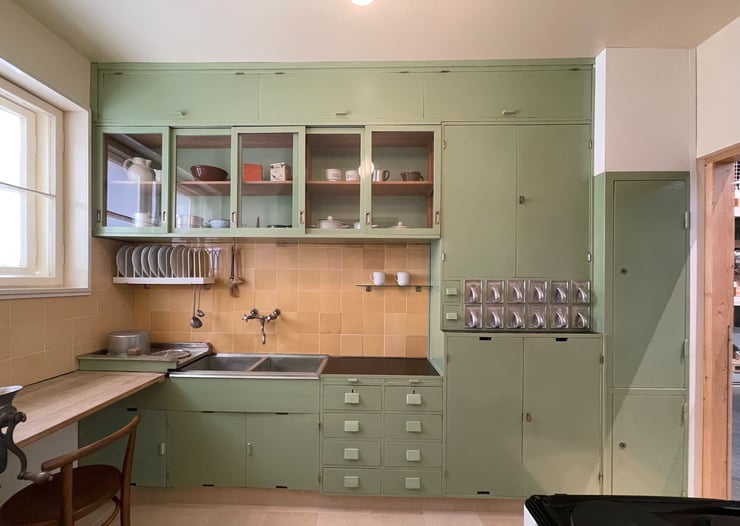
Frankfurt kitchen, designed by Margarete Schütte-Lihotzky. Photo by Frances Anderton
Still, the conceit of displaying objects just as they are, albeit in a highly composed way, started to wear a bit thin. I found myself drawn to the more curated pullouts: a complete Frankfurt kitchen, designed for social housing in Frankfurt in 1926 by Austrian architect Margarete Schütte-Lihotzky, above. Edgar Kaufman’s 1937 Pittsburgh office, designed by Frank Lloyd Wright, is there in its entirety, and, best of all, the David Bowie Centre, which opened last September.
The legendary singer, actor, and performance artist left his archive of outfits, papers, photographs, letters, shoes, and more to the V&A. Vitrine after vitrine enshrine Bowie's many transformations, displaying, said Bennett Stein, his "urgent relevance and iconic fabulousness, like a brilliant heretic who is describing how to live in the future.” There is an accompanying “study room” for scholars, though nothing says you’re getting old more than seeing the pop kings of one's childhood become objects of "study."
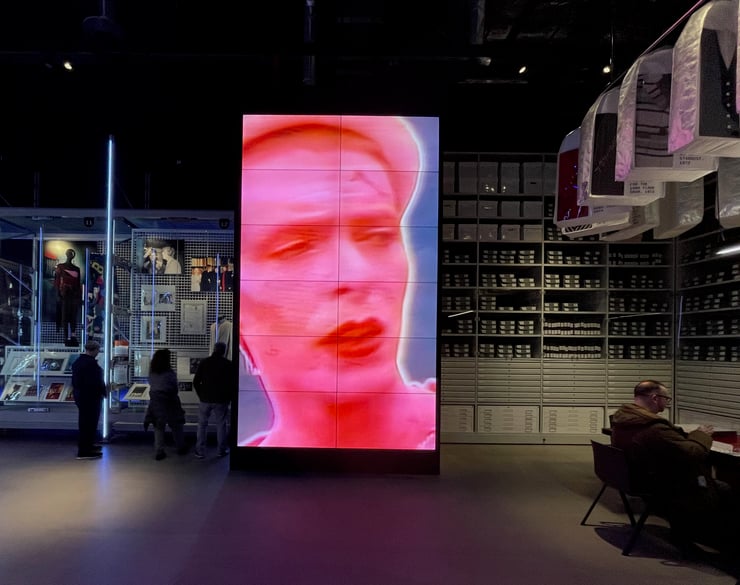
Inside the Bowie Centre; photo by Frances Anderton
Notably, the Bowie collection was behind glass, carefully edited and labeled. Elsewhere, without a curatorial narrative, objects started to feel depleted of their significance, reduced to just so much stuff, as jams garages, showers, and storage units across town.
The V&A was established at the peak of Britain's industrial power, with the goal of prodding designers and manufacturers to improve the quality of the nation’s art and design products. Today, the UK is largely a service economy, consuming far more goods than it makes. This museum feels like a celebration of consumption. It is artfully done, an extremely elegant take on Grandma's attic, or an auction house, but it felt, said Bennett Stein, like a “temple to hoarding.”
|
|
|
|
|
|
|
|
|
Design Things To Do
Wellness, Design & the Spaces We Inhabit
Tuesday, February 10th, 6:00 PM
The Aster, 1717 Vine Street, Los Angeles, CA 90028
Rachel Melvald is a designer and author of Psychitecture , a very interesting book about applying neurodesign principles in residential spaces. Tonight she will sit down with Karen Spector, co-founder of Lovers Unite branding firm, Terremoto's Nina Weithorn, and moderator Marissa Gluck, to explore the "practical applications of — from how natural elements and spatial flow affect our nervous systems to the role of intentionality in creating homes that feel as good as they look." It's at The Aster hotel in Hollywood, co-presented with The Los Angeles Forum for Architecture and Urban Design (L.A. Forum).
Click here for more information
+
The Client and the Architect
Architecture as a Listening Practice
A BENEFIT for PAUSE
Saturday, February 21st, 3:30 PM–8:00 PM
When Tim Tattu, a Zen Buddhist monk and hospice nurse, decided to build a house, he asked his architect, Tom Marble, for a design that was “sustainable…fireproof…and sexy.” Find out more about the collaboration and the resulting home — Tattuplex — at L.A. Forum's PAUSE event.
This event is a fundraiser to support the production of the second edition of PAUSE, a publication documenting the experiences of those affected by the Eaton Fire.
Tattu and Marble will reflect on the “listening” process between the two that produced its playful hexagon-based design, followed by a sunset reception at the Silver Lake house.
Click here to buy tickets.

Tattuplex, designed by Tom Marble for Tim Tattu. Image courtesy Taiyo Watanabe
Palm Springs Modernism Week
Thursday, February 12th - Sunday, February 22nd
Elizabeth Diller gives Keynote at Annenberg Theater, Saturday, February 14th, 1:00 PM
Palm Springs Modernism Week is back (how time flies!), bringing its usual fizzy cocktail of talks and bus and home tours (including The Marquee at Twin Palms (top of page and below), the Berman-Rubin Residence, the Lautner Compound, Temple Isaiah, and Sunrise Park), and the bumper Modernism Show.
At the more scholarly end is a line-up of visiting experts on Modernism in California, Brazil, the Czech Republic, Montevideo, Mexico, and beyond. Plunging us into contemporary design is the annual keynote, delivered this year by Elizabeth Diller, founding partner of Diller Scofidio + Renfro (DS+R), designers of the above-mentioned V&A Storehouse and many other conceptually provocativeFriday buildings.
Click here for tickets to the Elizabeth Diller keynote. Click here for the full schedule.
 The Marquee at Twin Palms, retrofitted by H3K Home + Design. Photo Credit: DaveFolks/Atomic Ranch The Marquee at Twin Palms, retrofitted by H3K Home + Design. Photo Credit: DaveFolks/Atomic Ranch
Wunderkammer
Rita McBride at Blue Heights Arts and Culture
Saturday, February 14th to Sunday, March 8th; Visits by appointment only
+
Dear Little Friend: Impressions of Galka Scheyer
Norton Simon Museum
Friday, February 20th – July 20th, 2026
The German-Jewish emigré Galka Scheyer was a visionary art collector and dealer who championed the "The Blue Four” painters (Lyonel Feininger, Wassily Kandinsky, Alexej von Jawlensky, and Paul Klee).
When she arrived in Los Angeles, she lived at Schindler House, where she met Richard and Dionne Neutra and then commissioned Neutra to build her a house on a precipitous site in the Hollywood Hills, at the end of a street she named Blue Heights Drive.
The 1933 house served as her home, a gallery and shelter for artists and intellectuals until she died in 1945, when it became a private residence for 80 years. Now owned by a German art collector, it has been restored as a cultural venue.
Starting this Saturday, you can visit the house transformed by artist Wunderkammer, or Cabinet of Curiosities, an installation by artist Rita McBride, presented by Del Vaz Projects & Okey Dokey Konrad Fischer. Expect to see “an amalgamation of past and in-process works hung and placed randomly… — relevant in its immediate relation to the artwork that it surrounds and the architecture that surrounds it.”
Meanwhile, the Norton Simon Museum is hosting Dear Little Friend: Impressions of Galka Scheyer, a show of portraits and ephemera collected by Scheyer. It features contributions from the Blue Four as well as artist-friends she made in LA, including Maynard Dixon, Peter Krasnow, Edward Weston, and the inimitable potter Beatrice Wood.
Click here to reserve a visit to Blue Heights Arts and Culture.
Click here for info about Dear Little Friend.
 The sunset turns the balcony orange at Galka Scheyer house. Photo by Frances Anderton The sunset turns the balcony orange at Galka Scheyer house. Photo by Frances Anderton
From Strand to Sculpture: Contemporary Japanese Basketry
The Gamble House
4 Westmoreland Place, Pasadena, CA 91103
Through April 12th, 2026
The craftsman architects Charles and Henry Greene drew deeply from the art and design of Japan, as did their clients, David and Mary Gamble.
Now you can see the 1908 Gamble House filled with contemporary bamboo art, crafted by Japanese artists.
Works range, says the museum, from “precise and contained vessels to dramatic sculptural forms that show the expressive power of bamboo. All have been chosen with the theme of the elements, echoing the importance of nature as a theme in the design of the Gambles’ home.” Beautiful.
Click here for more information.
 2016 Morigami, Big Wave, TAI Modern, Collection of the Carl & Marilynn Thoma Foundation, © Artist or artist estate 2016 Morigami, Big Wave, TAI Modern, Collection of the Carl & Marilynn Thoma Foundation, © Artist or artist estate
|
|
|
|
|
|
|
|
|
|
|
|
|
|
|
|
|
|
|
|
|
|
|
|


piefest/email(600x74).png?upscale=true&width=1200&upscale=true&name=email(600x74).png "email(600x74)")