PRACTICAL MAGIC
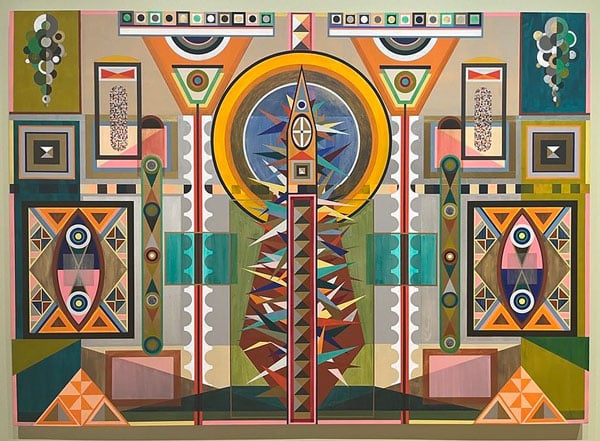
A 2023 painting by Hilma's Ghost (Sharmistha Ray and Danielle Tegeder) is inspired by abstractions of a popular tarot card deck. (Carolina A. Miranda)
Perhaps the most addictively charming astrological account on Instagram is @spellboundsky, run by the charismatic proprietors of the esoterica shop of the same name, where you can buy incense with names like “Not Today Satan.” On their page, you might catch owners Mark Phillips and Martin Anguiano in their stylish, all-black looks — which they’ve described as “Elvira in Comme des Garçons meets Liberace in Rick Owens” — dancing to mark the end of Mercury in retrograde or showing off their unicorn. Anguiano also does poolside astrological forecasts, reminding his “babies” to “get your shit together.” As a messy Scorpio, all I gotta say is: message received.
Previously based in Silver Lake, Spellbound Sky is firmly established in Palm Springs — and right now represents a particularly cosmic time to visit, because just three minutes down the road, the Palm Springs Art Museum has an engrossing group exhibition devoted to how queer artists across generations have embraced magic and mysticism in their work. A Queer Arcana: Art, Magic and Spirit, curated by the always intriguing David Evans Frantz, brings together works by 35 artists grouped around themes like occultism, eroticism, and the reimagining of the tarot deck.
The latter display includes the Amazon Tarot (1979), by Billie Luisi-Potts, which replaces the male figures of the major arcana with feminized figures such as the Witch and the Matriarch. Also on view is an absolutely beguiling deck created in 1992 by the trans activist Rachel Pollack. Called The Shining Tribe Tarot, it turns to nature for its iconography, featuring illustrations inspired, in part, by prehistoric art.
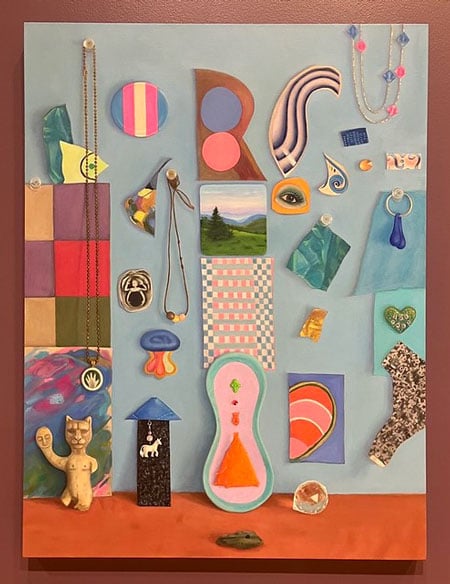
Clarity Haynes, Altar for the Protection of Trans Children, 2025. (Carolina A. Miranda)
To be certain, A Queer Arcana is about much more than tarot decks. The show’s exploration of mysticism in a queer context highlights the ways sexual and gender minorities, whose existence is continuously called into question, turn to esoteric practices as a form of spiritual armor and resistance. Greeting visitors to one of the early galleries is a sequence of four paintings by Clarity Haynes that are inspired by shrines she builds in her studio. One is in honor of the late queer Chicana photographer Laura Aguilar. Another is offered as a talisman of protection for trans children and includes objects bearing the colors of the trans flag. At its center is an image of a small, verdant landscape that seems to beckon as a place of sanctuary.
The exhibition draws from the past. Among the objects on view is a 1932 canvas by the U.S.-born Modernist Marsden Hartley that pays tribute to Richard Rolle, a 14th-century hermit and Christian mystic. In it, you see the letter “R” set within a triangle (a symbol of the Christian trinity) hovering over a brilliant red rock landscape. Also on view are the visionary drawings by early 20th-century British occultist Austin Osman Spare, who created potent sigils (symbols used in magic) as well as drawings of spirits that would ultimately influence countless other artists — including the gender-bending musician and artist Genesis Breyer P-Orridge, who is also represented in the show.
Prominently displayed are works by artists well known for their connection to mysticism and the occult, such as the notorious Cameron (born Marjorie Cameron Parsons Kimmel). On view is her drawing, Peyote Vision (1955), showing a spirit-like figure penetrating a woman — a work that led to the arrest of artist Wallace Berman in the 1950s for including it in a show at the fabled Ferus Gallery on La Cienega. But Queer Arcana also contains surprises, including Fred Lonidier’s photographs of the pagan-inspired wedding ceremony held by the late experimental composer Pauline Oliveros and cellist Lin Baron, as well as some remarkable wool tapestries by Tamara Gonzalez, bursting with explosive patterns, inspired by an ayahuasca ceremony in Peru.
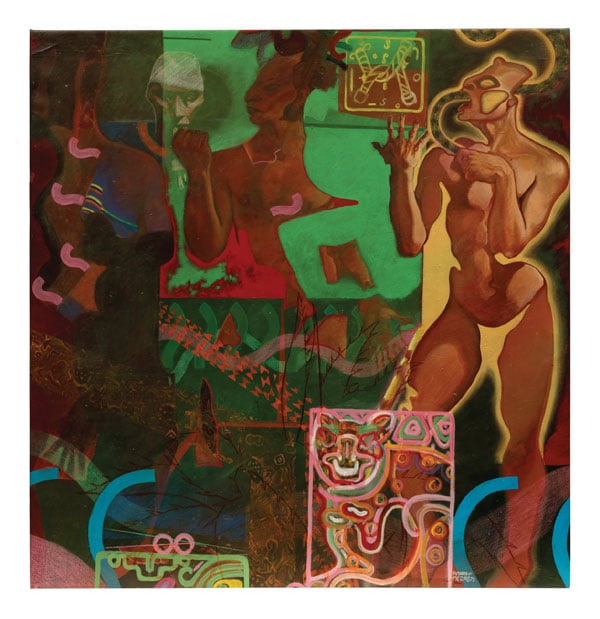
Mundo Meza Mundo Meza, Fusion, 1975.. (Frederik Nilson / Collection of Pat Meza)
The show engages serious themes, but it is also good fun. A series of Elijah Burgher’s colorful, abstract geometric canvases are inspired by ritual, and a charming four-minute video by Nao Bustamante, Mucho Mucho (2020), pays tribute to the over-the-top aesthetics of the legendary Puerto Rican astrologer Walter Mercado.
I felt so buoyed after seeing the show, I headed right to Spellbound Sky, where Anguiano showed me his personal tarot decks and I picked up Ashley Molesso and Chess Needham’s fantastic Queer Tarot. The first card I drew was the Knight of Cups, showing a person riding a horse, holding aloft a goblet from which emanates a rainbow. Its meaning: charm, creativity, empathy.
Hopefully I’m on the right track.
🔮🔮🔮
A Queer Arcana: Art, Magic, and Spirit is on view at the Palm Springs Art Museum through October 18th; psmuseum.org.
kzUPGBbtP1b/Trustworthiness%20Banners/email(600x100).png?upscale=true&width=1200&upscale=true&name=email(600x100).png)


.png?upscale=true&width=1184&upscale=true&name=Wave3email(600x74).png)