SACRED SPACES
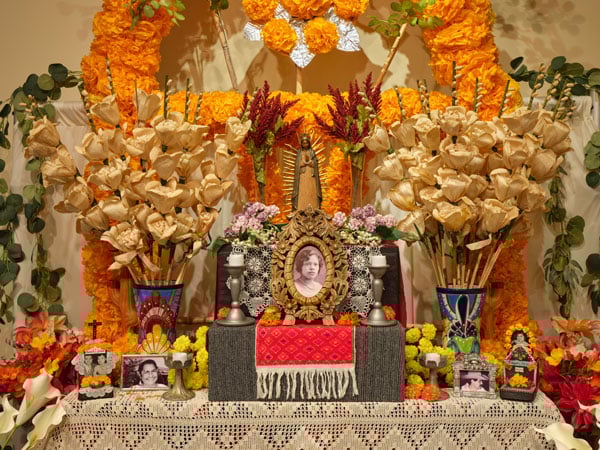
A detail of Ofelia Esparza's family altar, Recuerdos Que Nunca Mueren, c. 2022. (Paul Salveson)
In the 1970s, Ofelia Esparza was living in East LA and working as an elementary school teacher when she happened to pop into Self Help Graphics & Arts, then a relatively new community art space on the Eastside. There, Esparza met Self-Help’s charismatic founder, Sister Karen Boccalero, who asked her if she knew anything about Día de los Muertos traditions. Boccalero, it turns out, was asking the right person: Esparza was a sixth-generation altar maker whose Mexican mother maintained Purépecha spiritual traditions. Esparza had barely uttered the word yes when Boccalero had already enlisted her to teach a class. As Esparza later recounted to the Los Angeles Times, Boccalero told her, “‘You come Saturday, and you’re going to do a workshop.’”
That fortuitous encounter helped shift how Day of the Dead is celebrated — helping turn what had once consisted largely of private commemorations into a communal event. Self-Help organized ebullient, costumed processions through Boyle Heights to honor the day. And Esparza became renowned for creating colorful, large-scale altars that were collectively built. In fact, she helped pioneer the Day of the Dead altar that materializes every year in downtown LA’s Grand Park, where Angelenos go to honor their dead. Over the years, she has also built her own personal altars in art spaces, concert halls, and museums (including one as far as Scotland). Her influence has been such that in 2018, she was awarded the NEA’s National Heritage Fellowship, the nation’s highest folk art honor.
Now an exhibition at the Vincent Price Art Museum pays tribute to the full breadth of Esparza’s work — which includes not just the altars for which she is known, but also drawings, prints, paintings, and installations that push the format of the altar to its limits. Among the most striking is a piece titled My Tree of Life (c. 2000), which displays translucent images of the artist’s ancestors on a life-size sculpture of a maguey plant. The retrospective, she told LAist, is “beyond anything I’ve ever done. It’s all the stages of my life.”
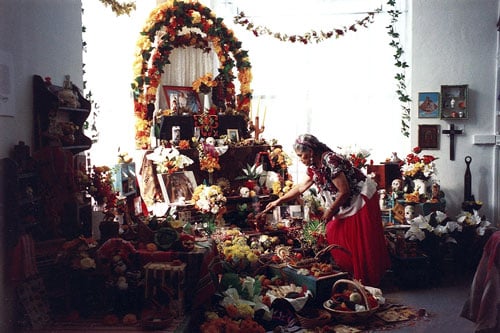
Ofelia Esparza tends to one of her elaborate altars. (Courtesy Ofelia Esparza)
Curated by Joseph Valencia and Sybil Venegas with Gloria Ortega, Ofelia Esparza: A Retrospective gives the broad arc of this singular artist’s story. Born Ofelia Rivera in East LA in 1932, Esparza took to drawing at a young age, encouraged by her mother, Mama Lupe, who would iron sheets of butcher paper for her daughter to draw on. By the time she was a teen, Esparza was producing still lifes and portraits of friends, family members, and movie stars like Ava Gardner. It was a practice she maintained after she married Army veteran Amado R. Esparza in 1950, with whom she had nine children. A tender charcoal sketch from 1971 shows a swaddled infant tucked into a bassinet.
In her forties, Esparza transitioned to a professional teaching career, and her art practice expanded to include painting and printmaking. (Self-Help, after all, achieved fame as an important printmaking center.) In the show, you’ll find her watercolors from the ‘90s, bursting with abundant fruits and ears of corn; silkscreens she made the following decade capture the drama of Southwestern landscapes. The expressionistic Paso del Norte (2009), for example, shows a series of buttes in fiery shades of red, pink, and orange.
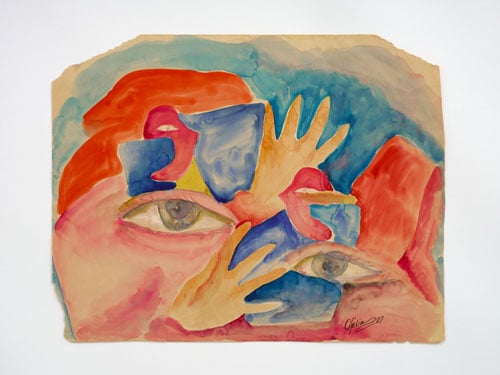
Ofelia Esparza, Outreach (Self-Portrait), 1987. (Paul Salveson)
But ultimately, it’s her dazzling altars that are the stars of this show. Greeting visitors to the gallery is Recuerdos Que Nunca Mueren (c. 2022), a towering, multi-tiered installation that honors the artist’s family. It is framed with orange paper flowers evocative of cempasúchil (marigold), a plant whose ceremonial use is rooted in Indigenous ritual. Framed photographs of loved ones are surrounded by lush arrangements of candles, flowers, decorative objects, and topped by an icon of the Virgin. Altars, Esparza has said, are a way for one generation to pass on a legacy to the next: as a family comes together to build it, the lives of ancestors “are told or narrated so that the subsequent generations know who they were and where they came from.”
While the show opens with a traditional altar, Esparza’s installations range in subject and form. In the galleries of the Natural History Museum in Exposition Park, for example, you’ll find a permanent altar by the artist that recounts 500 years of LA history (made with her daughter Rosanna Esparza Ahrens). Her show at VPAM likewise contains some of these remarkable pieces. A 2017 altar, first displayed at the National Museum of Mexican Art in Chicago, and also designed in collaboration with her daughter, pays tribute to environmental activists killed in the line of duty. It bursts with flowers and corn (symbols of life and renewal); a sign at the center reads “Walk Gently Upon This Earth.” I was moved by the overwhelming number of names incorporated into the piece — a vivid depiction of the mortal toll borne by ecological movements.
Nearby, another, more intimate installation, A las mujeres de mi alma (c. 2000), takes the form of an ornate bedroom and pays tribute to the women in Esparza’s life. The level of detail — from the lace doilies that bear vases filled with flowers and the sugar skulls tucked into a shadow box — is staggering.
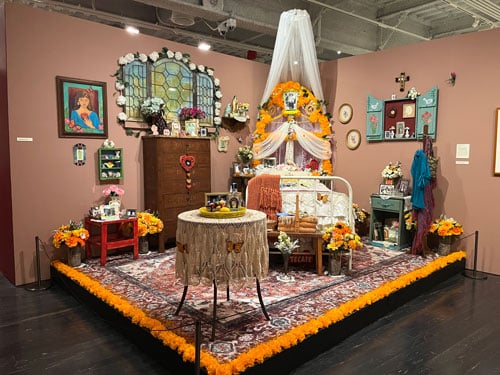
A las mujeres de mi alma (Bedroom Altar), c. 2000, takes the form of a bedroom, and was designed by Ofelia Esparza with Elena Esparza (Carolina A. Miranda)
Over the years, Día de los Muertos has been relentlessly commercialized, inspiring everything from Barbie dolls to pet costumes. Esparza takes us back to its true meaning. “Day of the Dead,” she told KCRW in 2018, “is not Mexican Halloween.” It’s a moment to reflect and to honor. Her show, therefore, couldn’t land at a better moment. The end of the year is a time to contemplate what is behind us and what lies ahead. And I can’t think of a better space in which to meditate on what fills us with meaning than Esparza’s gorgeous, warmhearted show.
🏵️🏵️🏵️
Ofelia Esparza: A Retrospective is on view at the Vincent Price Art Museum through April 18th; vpam.org.
On December 13th, Esparza and her family (who are integral to her altar-building process) will lead a walk-through of the show. The event is free, but advance registration is required.
-4.png?upscale=true&width=1200&upscale=true&name=email(600x74)-4.png)