Author’s note: I’m Arnie Seipel. I spent years covering politics and policy for NPR in Washington, D.C. Now, I’m the content chief at KCRW. With this weekly analysis of political news, I want to help you keep your head on straight when the onslaught of stories each week has you spinning.
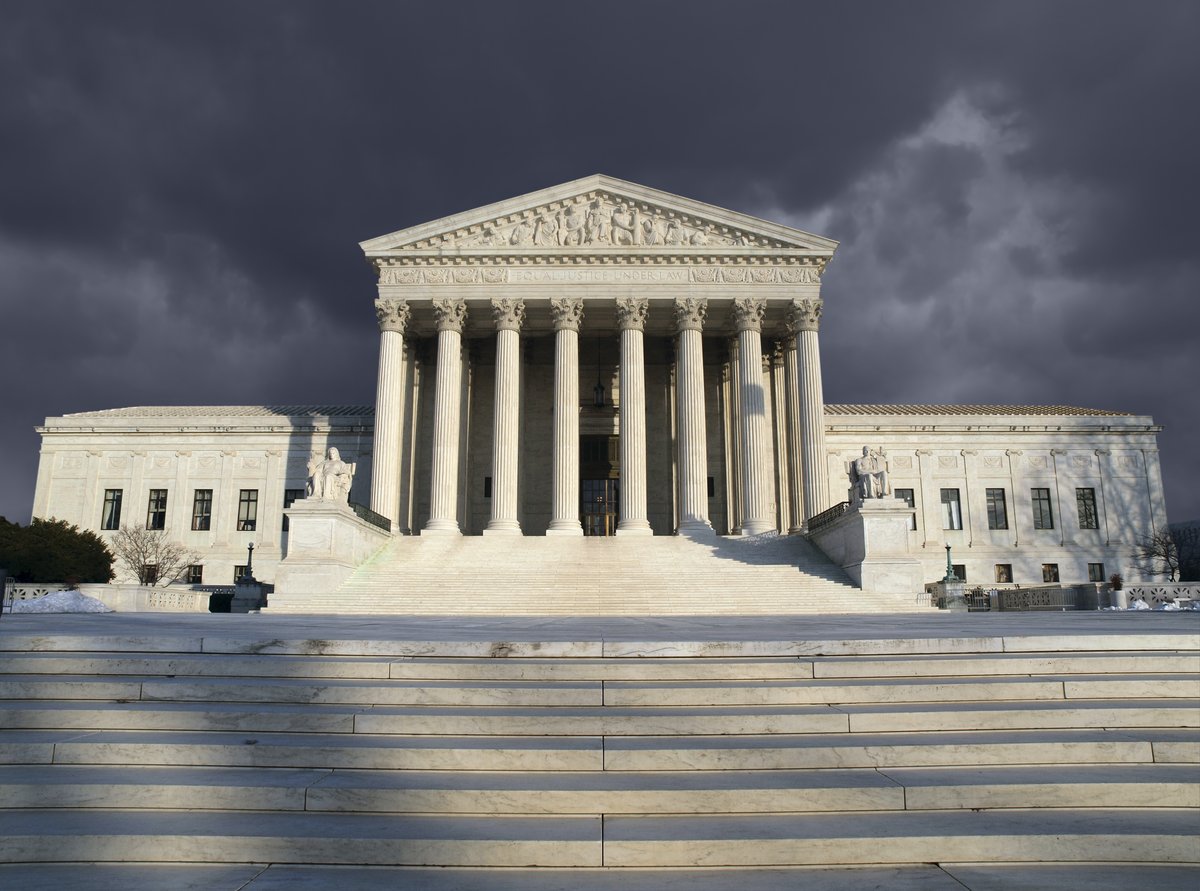
The U.S. Supreme Court on a stormy day. Photo by: trekandshoot/Shutterstock
Hi there -
When the Supreme Court struck down President Trump’s sweeping unilateral tariffs last week, the movie Mean Girls popped into my head a couple of different times.
The core of the president’s economic policy, one that he’s been laser-focused on since the ‘80s, was gutted four days before the State of the Union. I was imagining the scene in the White House speechwriting office resembling Regina George’s crash-out. You know, the moment she’s triggered to spread the Burn Book all over school.
What struck me from Trump’s speech last night was his assertion that congressional approval won’t be required for his new tariffs, which means he’d be using very limited powers to enact limited tariffs. That line may have really been a promise to Republican lawmakers that he won’t make them take a recorded vote ahead of the midterm elections on an unpopular policy.
I’m still thinking more about the Supreme Court’s ruling. This past weekend, I noticed there was a lot of buzz, both sweet and salty, among legal nerds over Justice Neil Gorsuch’s opinion in support of the ruling.
Constitutional romantics were swooning over his defense of the separation of powers, asserting that Congress and the legislative process are “the bulwark of liberty.” His conclusion is worth reading in full:
For those who think it important for the Nation to impose more tariffs, I understand that today’s decision will be disappointing. All I can offer them is that most major decisions affecting the rights and responsibilities of the American people (including the duty to pay taxes and tariffs) are funneled through the legislative process for a reason. Yes, legislating can be hard and take time. And, yes, it can be tempting to bypass Congress when some pressing problem arises. But the deliberative nature of the legislative process was the whole point of its design. Through that process, the Nation can tap the combined wisdom of the people’s elected representatives, not just that of one faction or man. There, deliberation tempers impulse, and compromise hammers disagreements into workable solutions. And because laws must earn such broad support to survive the legislative process, they tend to endure, allowing ordinary people to plan their lives in ways they cannot when the rules shift from day to day. In all, the legislative process helps ensure each of us has a stake in the laws that govern us and in the Nation’s future. For some today, the weight of those virtues is apparent. For others, it may not seem so obvious. But if history is any guide, the tables will turn and the day will come when those disappointed by today’s result will appreciate the legislative process for the bulwark of liberty it is.
It’s the capstone of a scorching 46-page concurrence to the majority opinion (for perspective, the other opinions in support of the majority were each under 10 pages).
It turns out that it wasn’t just a judicial opinion. It was a high court Burn Book.
That last paragraph was more than a defense of legislation and liberty. Gorsuch was throwing shade at Congress for capitulating so much power to the executive branch instead of doing their damn jobs and making some freaking laws.
He also started his opinion slamming President Trump’s disregard for constitutional principles. Before he got to the end where he singed the legislative branch, he used most of his words to go after the third branch of government — his fellow justices. And he brought receipts.
Gorsuch dismantled the reasoning of colleagues who voted against him on the tariffs, and even those who voted with him, saying they were picking and choosing when they thought the president should be constrained by Congress. He cited what he saw as contradictions in their own prior opinions from cases involving the Environmental Protection Agency, federal student loans, the Occupational Safety and Health Administration, and on and on.
It’s all very weedy, except when he goes straight-up School House Rock on Clarence Thomas’ defense of Trump’s tariff power.
“Justice Thomas suggests all that is possible because, at the founding, the tariff power was considered a ‘prerogative right’ of the British King,” Gorsuch wrote.
Yes, he’s referring to the Boston Tea Party.
Gorsuch continued, “Are we really to believe that the patriots that night in Boston Harbor considered the whole of the tariff power some kingly prerogative?”
It’s elegant because it’s so accessible. Justice Gorsuch invokes a reference that even Regina George would have absorbed in history class.
ASKING: I tend to think the State of the Union is never as important or interesting as the coverage wants it to be. Did you watch? What did you think?
THIS WEEK’S OPEN TABS
The latest scoop from NPR: “The Justice Department has withheld some Epstein files related to allegations that President Trump sexually abused a minor.”
LA Times Sacramento columnist George Skelton sounds the alarm that the crowded Democratic field of candidates for governor could hand the office to Republicans.
This one is a tough read. Our frequent Left, Right & Center guest Liz Bruenig wrote a gripping piece for The Atlantic about the very real dangers of skipping routine childhood vaccinations.
From The Dispatch: “Ukrainian Children Reflect on Four Years of War”
Take care,
Arnie
If someone forwarded this to you and you want to subscribe, click here.
Disclaimer: This newsletter, “KCRW's Steady State,” is not affiliated with The Steady State, a nonprofit 501(c)(4) organization founded in 2016 and comprised of more than 390 former senior national security professionals. They advocate for constitutional democracy, the rule of law, and the preservation of America’s national security institutions.

kcrw-app/Yellow%20Background/email(600x100).png?upscale=true&width=1200&upscale=true&name=email(600x100).png "email(600x100)")