POWER UP
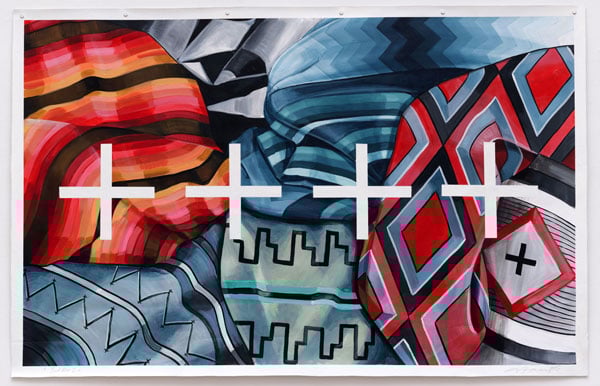
Nanibah Chacon, Bed rot (2026). (Timothy Hawkinson Gallery)
During a flash visit to New York City last month, I managed to see the latest iteration of the Whitney Biennial. It was a quick visit — I had a flight to catch — but was stopped in my tracks by the sight of three sculptures on one of the museum’s decks. Created by New Mexico artist Nanibah Chacon, they consist of three larger-than-life steel pieces that, on first impact, resemble electrical towers. But when you look closer, you’ll see that their forms evoke the Diné deities found in sand painting — anthropomorphic figures in spiked headdresses, each bearing decorative elements such as large metallic beads and dangling bells. Made of industrial materials, the sculptures camouflage well with the Manhattan skyline, which is cluttered with antennas, rooftop ventilation units, and water towers. But they nonetheless manifest as supernatural — as if a trio of otherworldly beings landed on earth and decided to take the form of the urban landscape around them.
If you can’t make it to New York to see the biennial, the good news is that Chacon currently has a small solo show on view at Timothy Hawkinson Gallery in the Fairfax area, which features three of her small-scale steel pieces, along with a new series of paintings inspired by the concept of “bed rot” (the act of intentionally remaining in bed and being unproductive). Also on view is a new wall sculpture made from a rainbow of bright neon, a modern depiction of a Diné deity that connects heaven and earth.
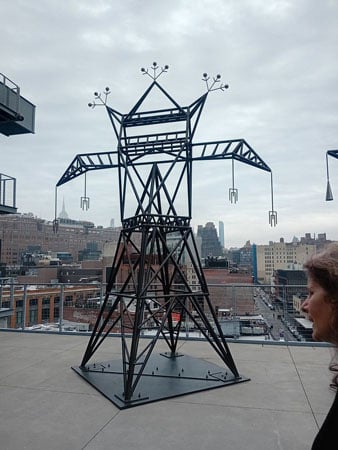
One of Chacon's sculptures at the Whitney Biennial: Our Gods Walk Among Us, 2026. (Carolina A. Miranda)
Chacon, who was born and raised in New Mexico, is of Chicana and Diné heritage and was raised on the Navajo reservation. She is perhaps best known as a muralist, crafting graceful compositions that feature a mix of nature and people, while also engaging social and environmental issues. Visit her hometown of Albuquerque, and you are bound to stumble into one of her works on a city wall (as I did in 2021). Likewise, if you live on the Eastside of LA, you may be familiar with her 2017 mural, ¡Resiste!, which showed two women with Indigenous features and the word “resist” in building-sized letters. For years, it occupied the western wall of the Self Help Graphics & Art building in Boyle Heights.
Her current show at Hawkinson, …And I’ll say, it could be worse (reflections on light through dark times), shows the artist exploring intimate spaces. The Bed Rot paintings feature piles of brightly patterned Diné blankets in abstracted settings that could be read as places to sleep — the time when we are most vulnerable. Bed rot implies decay, but Chacon counters with elegant combinations of color and pattern. Moreover, across some of the paintings, you’ll find the repeating images of a small cross resembling a plus sign, a symbol of the Spider Woman of Diné lore, who taught women how to weave — a figure that can signify benevolence and protection. The instinct to take to bed can reflect a desire to hide, to escape the darkness around us. But such a space can be a site of consolation and inspiration, too.
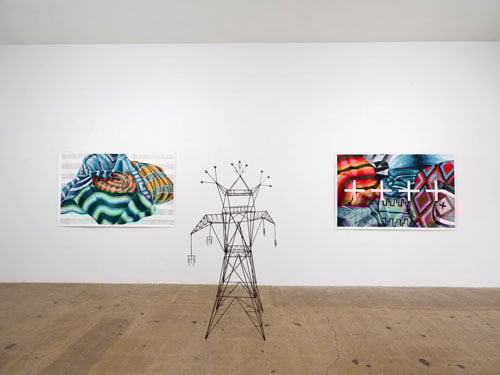
An installation view of paintings and a sculpture by Chacon at Hawkinson. (Timothy Hawkinson Gallery)
The steel sculptures likewise take contemporary concepts and fuse them with a Diné worldview. The coal refineries of the Navajo Nation are studded with masses of electrical infrastructure. Chacon was interested in exploring the idea of what it might mean to reconceive these structures beyond their utilitarian use. Could the electrical tower of today serve as the cultural artifact of tomorrow? Could something ordinary carry in its engineering an element of myth?
Like her pieces at the Whitney, the trio of steel sculptures on view at Hawkinson show her testing out those ideas to remarkable effect. Though these are finer and much smaller, rendered at a human scale (in the range of six feet), they are nonetheless captivating, allowing the viewer to come face to face with the divine.
The sculptures engage the forms within sand painting in an intriguing way. Traditionally, sand painting has been practiced as part of ritual ceremony, often for healing, painstakingly laid out on the ground, then destroyed upon a ceremony’s conclusion. One way to think about these works is as a temporary threshold where the human and spirit worlds meet. It is a site of great energy, which can be virtuous or bring with it the possibility of destruction. In our heavily industrialized, AI-addled society, an apt metaphor might be an electrical tower.
⚡⚡⚡
Nani Chacon, …And I’ll say, it could be worse (reflection on light through dark times), is on view at Timothy Hawkinson Gallery through May 9th; timothyhawkinsongallery.com.
The Whitney Biennial 2026 is on view through August 23rd at the Whitney Museum of American Art in New York; whitney.org.
kcrw-app/Win%20Tab%20Generic/WinTab_App%20Banner%20Suite-9-email%20(600x74).png?upscale=true&width=1200&upscale=true&name=WinTab_App%20Banner%20Suite-9-email%20(600x74).png)


kcrw-app/Win%20Tab%20Generic/WinTab_App%20Banner%20Suite-8-email%20(600x100).png?upscale=true&width=1200&upscale=true&name=WinTab_App%20Banner%20Suite-8-email%20(600x100).png)