PRIVATE EYE
by Joanne McNeil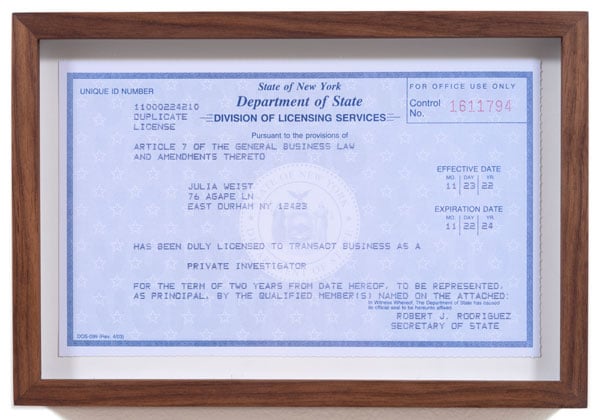
As part of an exhibition at LA's Moskowitz Bayse in 2024, Julia Weist recreated her private investigator's license as a print. (Julia Weist / Moskowitz Bayse)
In the fall of 2024, private investigator Julia Weist visited an office in Albany, NY, for what she believed was a routine process to renew her credentials. There, she discovered that the state agency that issued her license had opened a case challenging her background as an investigator. That’s because Weist is primarily an artist — who uses information she gathers as a private investigator to make visual art.
On that day, she was interrogated by government officials about how exactly her artistic projects qualified her for an investigator’s license. Under dispute were a series of collages that the artist made which employed images harvested from databases available to PIs, and which had been on view at LA’s Moskowitz Bayse gallery in 2024. Weist captured the entire exchange as an audio file on her phone. This recording now serves as the foundation of Questioning, a performance that is set to debut at the buzzy artist-run black box space, New Theater Hollywood, on July 10th.
 Weist creates collages out of data she finds on PI databases, such as Subaru Legacies in My Town (Wildcard Search for Self), 2023. (Julia Weist / Moskowitz Bayse)
As Weist aims to recreate this experience with accuracy on the stage, Questioning takes an unusual approach: actors will lip sync to the audio of the artist’s voice and that of the two investigators. Erika Mugglin, who plays Weist in Questioning, compares her preparation for the role to that of a musical performer. “You can't just work on memorizing the words, you have to memorize them in the exact rhythm that she's speaking them,” Mugglin said. Her script includes every “umm” and extensive notation to mark the cadence of Weist’s lines.
It’s the sort of ambitious production for which New Theater Hollywood has quickly become known. The 49-seat space, which opened in January 2024, often stages work by visual artists, musicians, and others for whom theater is a new formal challenge. Weist, who had no prior experience working in theater and is based in New York, was exclusively interested in assembling this piece at New Theater Hollywood.
.jpg?upscale=true&width=1000&upscale=true&name=02_New-Theater-Hollywood-interior.-Photograph-by-Calla-Henkel-and-Max-Pitegoff-(1).jpg)
The New Theater Hollywood will serve as the stage for Julia Weist's Questioning. (New Theater Hollywood)
“We always say a piece works when it could only happen here,” said Calla Henkel, who co-founded New Theater Hollywood with Max Pitegoff after running performance spaces in Berlin for over a decade. Shows sell out quickly at the space, which the LA Times recently dubbed an “IYKYK destination.”
Pitegoff and Henkel spoke with enthusiasm about the “ensemble” they have gathered through their LA productions. A film they shot at the theater was featured in last year’s Made in L.A. biennial at the Hammer Museum, and last fall, they wrote and directed a play at REDCAT working largely with a cast and crew they knew from the theater. Pitegoff credits the hype around the theater to the fact that “you have to be there.” Performances aren’t shared on social media.
New Theater Hollywood does create a single video of each performance for archival purposes, relaxing the policy against documentation of its performances that was practiced at the first theater Henkel and Pitegoff ran in Berlin. This is crucial to Weist, as the impetus for Questioning was that her requests for a copy of the video of her interrogation were denied by the State of New York. “I would not have made this production if they had transferred the video to me,” said Weist, “but in absence of that recording, I felt that there was an artistic opportunity to bring to life this thing that had been withheld from me.”
 Artist Julia Weist. (Adam T. Deen)
To qualify for a private investigator license in the state of New York, applicants need to demonstrate 6,000 hours of relevant experience. Weist cited public art commissions with the New York City Department of Cultural Affairs, including a project in which she scanned public records for information about the role of artists in civic life. She worked with the department as an artist, but also, as Weist explains, “I had a government contract to do research” — exactly the criteria that fits within the administrative rubric of private investigation. “Private investigator” as a title might conjure up gumshoes like Philip Marlowe in the public imagination, but as Weist demonstrates, this work largely involves desk research with access to troves of data assembled through surveillance mechanisms.
Some of the questions the investigators asked her drilled at the fine distinction between research and practice, and creative pursuit and labor. As Weist paraphrased to me, “Who are artists? What do they do, and how are they different than other workers?” Weist, who was confident her work was "designed to follow the exact letter of the law,” was “thrilled” by the exchange.
Further complicating the overlap between art and research, these two investigators became unwitting “collaborators” — as Weist put it — on this piece. Likewise, the attention they paid to her work became an inadvertent validation of her art practice. “The greatest success my work can accomplish,” Weist told me, is when experts in a field that she channels through her art “closely evaluate what it is that I'm doing.”
🔍🔍🔍
Questioning by Julia Weist is playing July 10th-19th at New Theater Hollywood; newtheaterhollywood.com.
Joanne McNeil is an author and critic based in LA.
standup/email(600x74).png?upscale=true&width=1200&upscale=true&name=email(600x74).png)


standup/email(600x100).png?upscale=true&width=1200&upscale=true&name=email(600x100).png)