A Dazzling Display
by Leigh-Ann Jackson
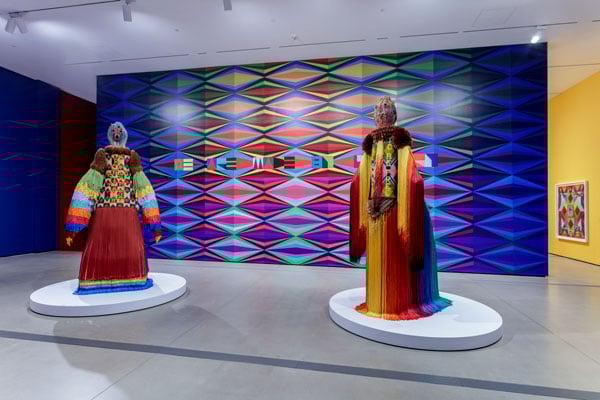
Jeffrey Gibson's show at the Broad has saturated the galleries in bold pattern and color. (Joshua White / JWPictures.com / The Broad)
While walking through Jeffrey Gibson: the space in which to place me, which opened at the Broad last week, it was hard to keep my eyes in their sockets. The painter-sculptor’s exhibition is an explosion of bold colors, enticing and exciting from the first installation to the last.
At the show’s entrance, a floor-to-ceiling mural marries the signature geometric patterns of traditional Native American textiles, like Navajo eye dazzlers, with the intense hues of late-’90s rave fliers. It serves as an invitation into an electrifying space that weaves together the stories of US history and culture, then refracts them through a kaleidoscopic lens.
Hypnotic collage work, crafted from materials such as paper, paint, and beads, is studded with snippets of historically significant texts that hold a mirror up to the present. In large-scale works, for example, Gibson incorporates lines from the First Amendment of the US Constitution and the Civil Rights Act of 1964, both of which are currently under threat. His work acts as a highlighter pen making sure the foundational passages pop.

A beaded punching bag sculpture bears the phrase, "We hold these truths to be self-evident." (Joshua White / JWPictures.com / The Broad)
The exhibition was previously on display at the 2024 Venice Biennale, where Gibson — a member of the Mississippi Band of Choctaw Indians, who is also of Cherokee descent — was the first Indigenous artist to present a solo show in the US Pavilion. Such an illustrious first seems like a long-overdue step in the right direction, but the prospects of further momentum look dim. Just this month, the US government announced new restrictions on 2026 pavilion applications, including attempts to curb proposals promoting diversity, equity, and inclusion.
At a press preview held in the Broad’s foyer, Gibson acknowledged, “It’s a really challenging time for institutions and for artists,” and went on to say he wanted the exhibition to instill “some of the hope people are looking for during this time.”
Indeed, after my morning spent doom-scrolling news headlines, his uninhibited approach to color felt like a balm for my soul — even as some of the most jubilant-seeming pieces revealed sobering backstories. The brightness pulls you in, the intricate details draw you closer, and the words impress upon you ideals the US has yet to fully live up to.

Gibson's presentation features Charles Cary Rumsey's famous sculpture, The Dying Indian, donning a pair of custom moccasins made by John Little Sun Murie. (Joshua White / JWPictures.com / The Broad)
Here are 3 things from the Jeffrey Gibson show that I won’t soon forget:
The mind-bending “Gibson alphabet”
It took several moments for my eyes to get accustomed to the stylized lettering Gibson employs in his acrylic paintings. It’s geometric, colorblocked, abstract, and backed by competing shades and shapes. Making out the words felt like deciphering a puzzle, and I ultimately used the wall plaques as decoder rings… which ended up being a good thing! If you merely view the works without also reading about the references that inspired them — which might include the so-called Indian New Deal of 1934, a soulful Nina Simone lyric, or the profound words of Booker T. Washington — you’re short-changing yourself.

Jeffrey Gibson, BIRDS FLYING HIGH YOU KNOW HOW I FEEL, 2024. (Joshua White / JWPictures.com / The Broad)
Beads on beads on beads
I’m a sucker for artwork that compels me to zoom in and observe layers of minutia. Gibson delivers this in spades, via a rainbow of glass, vinyl, and plastic beads. They’re woven together to make the custom frames that encase his paintings. They’re clustered alongside metal bells, tin jingles, and grosgrain ribbon to form a fiercely fabulous trio of sculpted busts and a pair of towering totems. They spell out the first words in the Declaration of Independence on an ornate punching bag. Gibson also affixes found artifacts, such as vintage beaded bags, belts, and sashes, to his paintings, honoring the traditional craftwork and keepsakes of tribes from across North America.
The “electric powwow” in the final gallery
Slip behind a pair of heavy velvet curtains and you’re transported into a show-closing warehouse party. Inside a dark room, the nine-channel video installation, She Never Dances Alone, features the footwork of Native American dancer Sarah Ortegon HighWalking moving to the pulsating beat of “Sisters,” a 2014 track by First Nations electronic act, The Halluci Nation. “Color, music, dancing … these are things that all our originating cultures shared at some point,” Gibson said in his opening remarks. With this piece, he aimed to recreate the sense of interracial community and joy he experienced in the hip-hop and house music scenes of the ’80s and ’90s. The visuals are trippy, the rhythm is undeniable, and, while the wide-legged pants I was wearing that day weren’t quite as voluminous as my JNCO-style jeans of yore, I nonetheless found myself dancing along like I would’ve back in the day. After processing some of the show’s weightier themes, it was a welcome moment of release and served as a reminder to carry the light away with me as I left.

An installation view of She Never Dances Alone, 2020. (Joshua White / JWPictures.com / The Broad)
🌈🌈🌈
Jeffrey Gibson: the space in which to place me is on view at the Broad through September 28th; thebroad.org.
Plus, David Pagel has a good profile of the artist in The Los Angeles Times.


%20(9).png?upscale=true&width=1200&upscale=true&name=email(600x100)%20(9).png "A banner ad for KCRW reads: Win an unforgettable three-night luxury escape to Allegretto Vineyard Resort in Paso Robles")