GIRL WORLD
by Paula Mejía
.jpg?upscale=true&width=1200&upscale=true&name=02-WALISZEWSKA-sfinks-jasny-poziomy-olej-24-kopia-100x60cm-(1).jpg)
Aleksandra Waliszewska, Untitled, 2024, is on view at Jeffrey Deitch. (Aleksandra Waliszewska)
As I walked to Jeffrey Deitch’s Hollywood gallery over the weekend to see the group show, It Smells Like Girl, a searing song from the ‘90s kept ricocheting around my head: Hole’s “She Walks on Me.” Written by the band’s talented and polarizing frontwoman, Courtney Love, the song is a furious indictment about how women trample each other as they claw their way to survival. On it, Love snarls: “Geeks do not have pedigrees / Or girls with punk rock resumes / Or anorexic magazines / It smells like girl, it smells like girl.” Love was taking a jab at self-identified feminists in the ‘90s-era music scene who valued inclusivity in name but flayed other women when given the opportunity. It incisively locates how, for all the righteous anger about the many structural issues that subjugate women, we often do a fine job of putting each other down.
It Smells Like Girl was organized by Deitch and New York City’s Company Gallery, and the song from which it draws its name stayed with me as I absorbed paintings, video installations, plaster and beeswax sculptures, as well as two disquieting puppet dolls by Jordan Strafer, legs akimbo with thousand-yard stares.
Organized loosely around the concept of hysteria — a pseudoscientific medical term that served as a catchall for any inexplicable condition in women — the exhibition includes 35 artists working in various media. Each of them interprets what it means to exist within a world that encourages marginalized groups to tear one another down rather than coalesce against the forces that created these conditions to begin with — a world that, since Ancient Greece, has been quick to dismiss women as suffering from “hysteria” rather than to investigate their legitimate reports of pain.
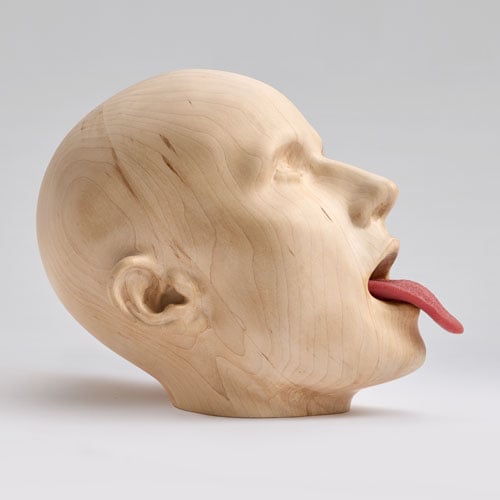
Isabelle Albuquerque, Head with Tongue, 2024. (Flying Studio / Isabelle Albuquerque / Nicodim)
The art collective Women’s History Museum presents a lithe mannequin wearing a measuring tape, scraps of fabric, and a skirt made of vintage fashion magazines. High heels lie at her feet, each of them impossible to walk in, given their towering height and unwieldy shapes; one pair of taupe pumps transforms into boxing gloves, as though ready to rear-hook along the catwalk.
Hysteria is well-trod terrain in art. The late Modernist Louise Bourgeois once took on the concept in The Arch of Hysteria, a bronze sculpture depicting a figure with its chest and pelvis arched heavenward. Her piece toyed with the idea, perpetuated by Sigmund Freud, that hysteria resulted in bodies involuntarily contorting themselves. That idea echoes through several pieces in the show, including the Swedish sculptor Cajsa von Zeipel’s Banana Follow Me. The mixed media sculpture sees a female figure with hips jutting unnaturally as her back bends, staring down the viewer with a pair of unnervingly-realistic cornflower blue eyes.

Kelly Akashi, TBC, 2025. (Kelly Akashi / Lisson Gallery)
You see the pose in the South Korean artist Eunnam Hong’s oil painting Opera, a piece that sees a woman lying on the floor, back arched, as she stares through a window. A string of pearls is wrapped around her arm; something that appears to be less a fashionable statement than it is a pretty chain keeping her tethered. A sculpture by the Iranian-born, LA-based artist Roksana Pirouzmand also sees five arched female figures, in tender repose. Here, the curvature of each of her subjects’ necks provides a resting place for another’s tired head, but the gesture is not without sacrifice: As they provide support for another, each of the clay figures secretes a liquid, as though bloodletting.
Perhaps taking a cue from a recent spate of female-driven body horror, like last year’s Academy Award-winning The Substance, the exhibition veers towards the visceral. Blood, guts, and hair are represented unsparingly. In Gutted, by the California-born transgender artist Tosh Basco, oil paint intermingles with other media to emulate blood, recalling the grit of clots as the body attempts to heal itself after trauma. Bárbara Sánchez-Kane’s Parasite or host? features polyurethane forms that wrap around uterine-esque aluminum pieces. Tongs refashioned into clothes hangers linger at a close distance.

Bárbara Sánchez-Kane, Parasite or host?, 2023. (Dan Bradica / Bárbara Sánchez-Kane/ Kurimanzutto)
It Smells Like Girl coincides with a raging American culture war actively celebrating women leaving the workforce and limiting access to reproductive health. But what’s especially intriguing about it is that it deviates from the typical approach of denouncing hysteria. Rather, it considers the stubborn inevitability of its presence and proposes a different solution that doesn’t involve mere resignation: Preposterous times call for preposterous measures. As the press release notes: “As society continues to oscillate between revering and rejecting female strength, It Smells Like Girl asks what choice is left but to embrace the spectacle?”
That framework results in a forum for disquieting and fascinating sensations — and, in the case of Meriem Bennani’s Umbrella Slap, it literally sends tremors throughout the gallery. The Moroccan artist assembled three spherical orange blobs with flat screen TVs, where bizarre images of a cartoon crocodile play on loop. Above it, what appears to be a metal clothesline with several beaded ropes rotates constantly, the ends of the ropes smacking the gallery walls. These had already created clear indentations by opening day, which will grow more marked over time.
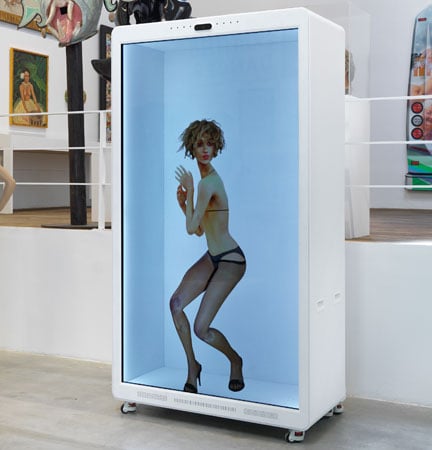
Nadia Lee Cohen, Entitled, 2025. (Genevieve Hanson / Nadia Lee Cohen / Jeffrey Deitch )
Nearby, the British photographer Nadia Lee Cohen’s disturbing Entitled presents the video avatar of a nearly-nude woman who, in a glass box, preens for the viewer, encouraging them to interact with her. But the more viewers reach out, the more the figure becomes bruised — as if the more she yearns for the validation of the world around her, the more she hurts herself.
👩👩🏿👩🏽
It Smells Like Girl is on view at Jeffrey Deitch through November 1st; deitch.com.


kcrw(q-mark)t=NEWSLETTERS/Member%20Text%20General%20Promo(600x74).png?upscale=true&width=1200&upscale=true&name=Member%20Text%20General%20Promo(600x74).png "Member Text General Promo(600x74)")