FRIGHT CLUB
By Paula Mejía
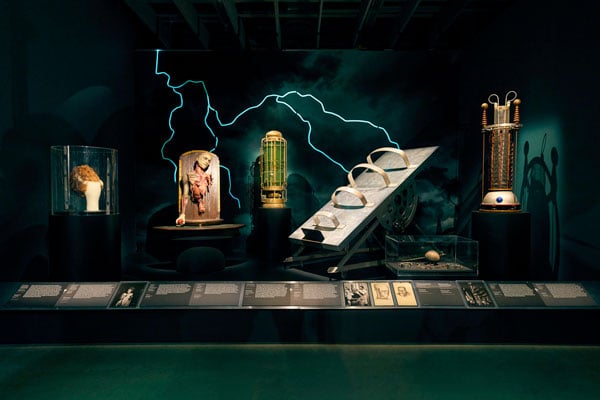
An installation in The Horror Show at the Academy Museum focuses on Frankenstein.
(Emily Shur / Academy Museum Foundation)
Enter the The Horror Show at the Academy Museum, an exhibit devoted to the history of bone-chilling cinema, and you’ll find yourself engulfed in near-darkness. I’m a weenie who watches most horror films through my fingers, so the prospect of walking into a haunted house-style experience makes me edgy. Turning the first corner, I half-expected to be greeted by an undead clown, or perhaps the ghost of a child. Instead, the museum has opted for something more intriguing: A small entry room humming with ominous sounds on loop. Playing overhead is audio including creaky doors and actor Haley Joel Osment whispering that he can “see dead people” (the familiar line from The Sixth Sense). Meanwhile, subtitled descriptions of these dreadful noises — “ghastly atmospheric rumbling” and “grisly reverberating tones” — materialize on a dark screen.
The room taps into something utterly human: How sensory stimuli, like the sudden snap of twigs in the distance, help humans evaluate and respond to threats. It’s an apt way to begin The Horror Show: For centuries, the horror genre has toyed with our subconscious reactions to potentially dangerous situations in hair-raising films. The Academy’s take on horror, which takes up the entirety of its fourth-floor gallery space, plumbs how the underlying themes of horror films often reflect distinctive socio-political and cultural anxieties — such as the 1979 sci-fi horror classic Alien, which grapples with themes of reproduction and control with its terrifying “facehugger” monsters.
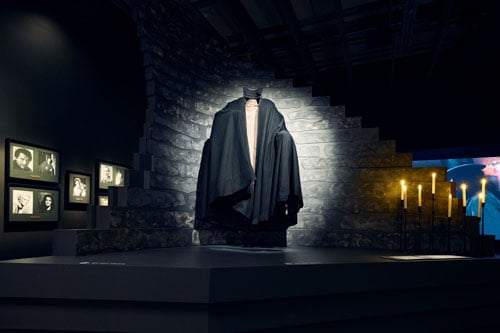
The cape worn by Bela Lugosi in Dracula. (Emily Shur / Academy Museum Foundation)
In recent years, the film industry has struggled to get audiences back into theaters. But horror has been a notable bright spot. Two scrappy feature films made by young first-time directors — Obsession and Backrooms — ignited the box office earlier this year, reviving hopes that horror could help lift a sagging industry. The genre has always been something of a life raft for the movie business. In its earliest days, Hollywood mined short stories by Edgar Allan Poe, and the tales of Nosferatu and Frankenstein, for enduring, fright-filled movies that helped build studios like Universal into international behemoths. Yet save for a brief wall of text near the front of the show, and dozens of beautiful original film posters lining the hallway leading into different rooms, the exhibition, unfortunately, doesn’t dwell much on horror’s role in shaping modern Hollywood.
The show focuses primarily on the props that have become recognizable signifiers of fear and the backbone of horror franchises like Saw. You’ll see the axe Jack Nicholson wields to terrifying effect in The Shining; the chair where Daniel Kaluuya struggles to wrest himself from the Sunken Place in Get Out (the teacup is there, too); along with the fearsome Chucky doll. Costumes also factor heavily into the show, including Florence Pugh’s flower-festooned gown from Midsommar, the all-black cyberpunk getup Wesley Snipes donned in Blade, and one of Leatherface’s masks as seen in The Texas Chainsaw Massacre. (The day I went, huge crowds swelled to snap photos of their favorite props and costumes, creating bottlenecks; for those whose worst fear is large groups, beware! Visiting earlier in the day might help.)
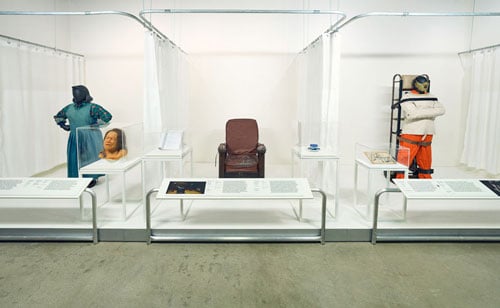
Props from Misery, Get Out and Silence of the Lambs. (Emily Shur / Academy Museum Foundation)
The Academy’s curators — led by Jessica Niebel — divided the exhibit into six major categories of horror film: Gothic, Psychological, Slasher, Science, Religion, and Ghosts. Yet the most intriguing facets of The Horror Show meditate on the promotional and technological advances that have helped horror cinema’s popularity surge.
One wall display, for instance, shows the insurance policy — underwritten by Lloyd’s of London — guaranteeing audience members $1000 should they undergo “death by fright” after watching the 1958 film Macabre. To tackle The Blair Witch Project, the museum lets audiences click around on a ‘90s-era desktop computer that recreates the film’s mysterious promotional website, which fueled curiosity and urban legends about the docu-style flick. And, in the “Ghosts” section, a living room with a heavy wooden console and a couch invites museum-goers to watch a selection of movies like The Ring — which featured its spirit crawling out of a television set — gesturing at how the emergence of home VHS tapes helped expand horror’s distribution and become a mechanism for cult film to thrive starting in the 1980s.
To visitors on a Halloween bender, the experiential facets of the exhibit will likely be enough. And there are plenty of those: you can take a photo with Norma Bates’ skeleton (of Psycho fame) via a two-way mirror; you can also snap yourself in a vampire coffin. It’s good, creepy fun, albeit light on meatier context. If you want something deeper, however, you might do best by turning to Darryl Jones’s 2021 book, Horror: A Very Short Introduction.
Leaving the exhibit will require you to pass one last test: getting through a blood-soaked hallway and out the doors.
⚰️⚰️⚰️
The Horror Show is on view at the Academy Museum through July 25th; academymuseum.org.
While you’re there…
For something different, head to the museum’s Marilyn Monroe exhibit, part of a year-long celebration of what would have been the icon’s 100th birthday. The display ruminates on her trajectory as an actor, displays a handful of her personal effects, and showcases the infamous subway grate dress.
Paula Mejía is a culture writer based in LA. Her work has appeared in The New Yorker, Texas Monthly, The Atlantic, and GQ.