In this newsletter:
- Feature: Not all art forms in Hollywood are having a slowdown
- Long Beach’s astronomical aspirations
- Day dancing: you don’t need to get drunk to get down
- City Councilmember Nithya Raman shocks LA’s political world
-Feb-13-2026-12-21-36-3038-AM.png?upscale=true&width=1200&upscale=true&name=Button(600x100)-Feb-13-2026-12-21-36-3038-AM.png)
Hollywood Production Booms … Vertically
by Megan Jamerson
Work is painfully slow in Hollywood right now, but as I recently reported, that is not the case for vertical microdramas — bingeable, campy shows made to be watched on your phone in episodes that cycle past in 90 seconds or less.
Verticals generated $1.3 billion in the US in 2025, according to the streaming consultant Owl and Co., as millions of people watched shows like Fake Married to my Billionaire CEO, Watch Out I’m a Lady Boss, and Kissing The Wrong Brother.
Revenue comes from advertising and the fees people pay to watch the shows. Now, studios like Fox and Disney are investing in the medium. This all feels ironic after the very expensive failure of Quibi in 2020.

A set photographer takes stills of Royce Lundquist and Madeline Massingill, the lead actors in To Her Beat, a new vertical produced by Chera TV. Photo by Stella Merims/KCRW.
The success of verticals, and their appeal to a mostly female audience, has echoes in the history of cinema, says cinematographer Michael Pessah, who teaches at the American Film Institute.
“One hundred and ten years ago, when cinema was still sort of working out what its language was, you had these serialized melodramas that, maybe not coincidentally, really spoke to the female audience of the time,” says Pessah. “These were some of the first really, really successful narrative films.”
Pessah says today’s verticals remind him of music videos in the 1980s and ‘90s, which launched the careers of filmmakers like Spike Jonze.
“Music videos were a place for innovative voices, and people with ambitious and new ways of seeing the world,” he says. “It became this hotbed of experimentation and a second film school for so many filmmakers.”
 Notice how the camera monitors on Chera TV’s set are vertical? Photo by Stella Merims/KCRW.
Today, verticals appeal to production companies because of the price tag: most cost between $150,000 and $200,000 per show (one show can have 60 to 90 episodes). That’s because they are shot on simple sets, quickly (but not on phones — on real cameras), and most of the work is non-union.
Verticals are employing a lot of people — IMDB identified 1,451 productions in 2025. So I arranged to spend an afternoon with Chera TV, a new Encino-based production company and streaming platform that makes verticals. Their phone app releases April 1st.
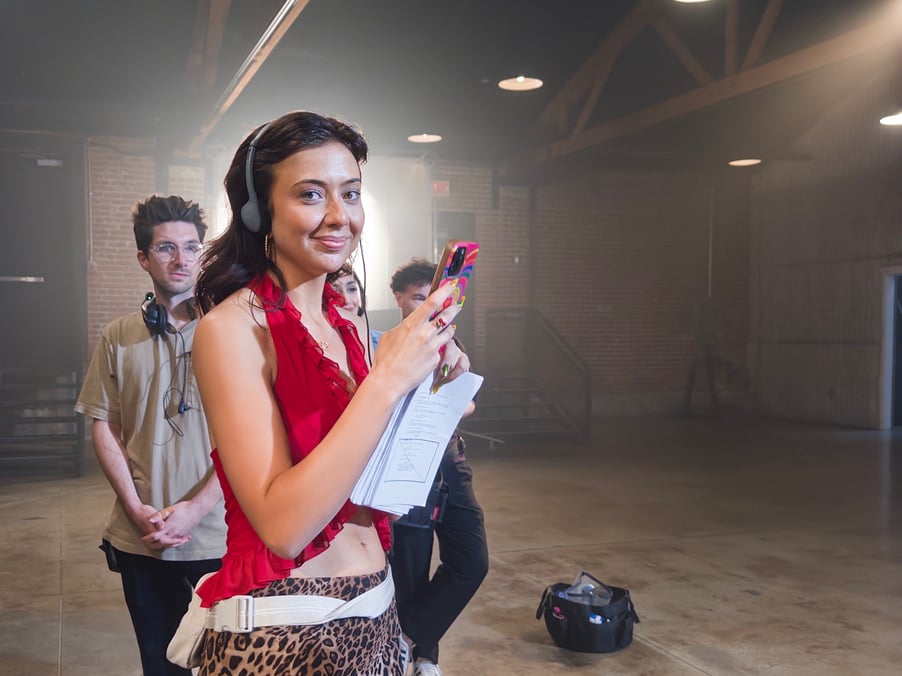
Kylie Karson, a co-founder of Chera TV, on set directing To Her Beat.
Photo by Stella Merims/KCRW.
Co-founder Kylie Karson moved to LA in 2022 to act, and started working in verticals full-time in 2024. She describes the company as a creator-led artistic space that pays workers fairly and prioritizes set safety.
“There needs to be people in charge that actually care about the people making these projects,” says Karson.
She co-founded Chera TV with fellow actor Candace Mizga, who has acted in over 30 verticals in the last two years. It’s how she got her break in Hollywood right out of acting school at NYU.
“My main goal was never to be famous or to be huge. It was always just to be a full-time working actor,” says Mizga. “So for that to happen, it changed my entire life.”
The women wanted to start their own company after experiencing systemic problems in verticals. They complain about a lack of diversity in casting, and productions that don’t hire intimacy coordinators or stunt coordinators.
Also, “the male leads tend to get paid way more than the female leads, despite the female leads having more work to do,” says Mizga. “You'll see a lot of storylines that have quite a lot of misogyny in them, just unnecessarily.”
Ok, but if you pay the actors and the crew well, does the vertical business model still work?

Chera TV’s Chief Operating Officer Calvin Singh says yes: “We are currently shooting our third show. All of them have stayed under $200,000, and we've given people standard shoot rates in whatever city we’re filming.”
Singh says Chera’s savings come from shooting in places with sizeable film rebates, like Canada. They were able to keep their upcoming show, To Her Beat, in LA after they got a remarkable deal on a sound stage.
“We are trying to keep as much production as we can in Los Angeles,” says Singh. “However, that's not always doable.”
That could change. The city of LA is exploring a plan to roll out a $5 million fund to subsidize vertical productions here.
And while Chera TV isn’t unionized yet, Singh says they want to be. This fall, SAG created a new agreement for verticals. When Singh looked that over, he was pleased to see they were already offering actors more than SAG minimums.
“It was actually a big morale boost for us internally,” says Singh. “Because we’re like ‘Wow, what we’re doing is actually working.’”

piefest/email(600x74).png?upscale=true&width=1200&upscale=true&name=email(600x74).png "email(600x74)")

-Feb-13-2026-12-21-36-5178-AM.png?upscale=true&width=1200&upscale=true&name=Button(600x74)-Feb-13-2026-12-21-36-5178-AM.png "Button(600x74)-Feb-13-2026-12-21-36-5178-AM")


