TIED UP IN KNOTS
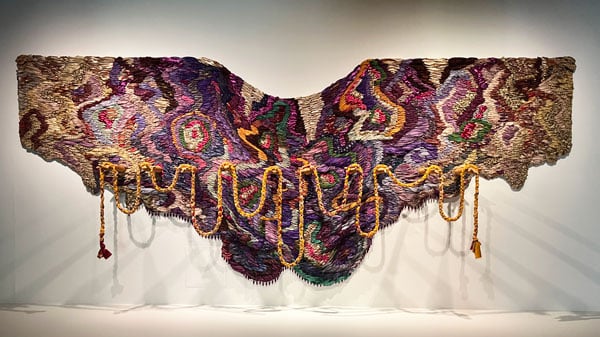
Suchitra Mattai, An Offering (2023), on view in Textiles as Monument. (Carolina A. Miranda)
In 1971, the Wight Gallery at UCLA opened an exhibition that reimagined the nature of textiles. Organized by ceramicist and textile designer Bernard Kester, whose works can be found in the collection of the Los Angeles County Museum of Art, Deliberate Entanglements showed that a textile could be more than something that hung on a wall.
Included in the show were more than a dozen artists transforming weaving into an architectural experience — including Neda Al-Hilali, whose installation, Nar, consisted of a massive form that descended from the ceiling like a ghostly spirit. When Entanglements travelled to Vancouver the following year, art critic Joan Lowndes described it as “revelatory.”
That historic exhibition came to mind as I stepped into Textiles as Monument, a small but worthwhile group show on view at the Fowler Museum at UCLA. Greeting viewers to the gallery is a sprawling installation by artist Suchitra Mattai that features a large-scale weaving in shades of pink, red, and gold that fills a pair of carved wooden door frames and then spills and puddles onto the floor.
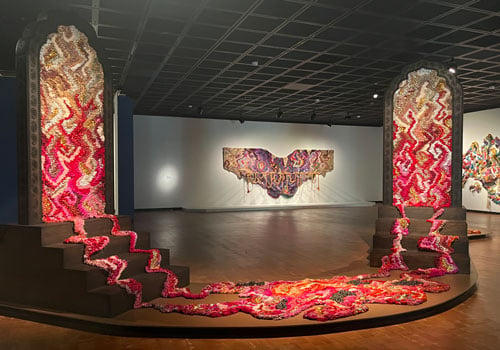
Suchitra Mattai, Estuaries (2025). (Carolina A. Miranda)
Mattai was born in Guyana to parents of South Asian descent who arrived in the Americas as indentured laborers for British plantations. The artist’s work, in its matter and form, often traces the legacies of these journeys. Her primary material consists of worn saris, a way of linking women scattered across continents by the forces of history. (Mattai is now based in LA.) Estuaries (2026), as her installation is titled, portrays the thresholds crossed when traversing from one world to the next. It’s a knockout.
Textiles as Monument was curated by Syona Puliady and presents weavings by three artists of South Asian heritage: Mattai, as well as Jagdeep Raina and Swapnaa Tamhane (who were both born in Canada). Altogether, their work examines the ways in which textiles hold memory and honor history, and perhaps offer a material counter-narrative to all those statues of bronze. Where Deliberate Entanglements was about expanding the forms that a textile could take, Textiles as Monument seeks to imbue them with additional meanings.
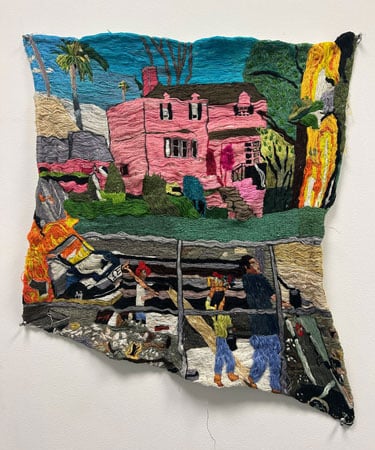
Jagdeep Raina, Beverly Hills (2025). (Jagdeep Raina / Fowler Museum)
Raina, now based in New York City, uses embroidery and quiltmaking to record the connection between a place and the often unseen immigrant labor that powers it. An embroidered tapestry titled Beverly Hills (2025), imagines workers contending with fire. A gridded quilt, meanwhile, features small embroidered scenes of the settings often inhabited by immigrants in LA: construction sites, bus stops, and one of the ubiquitous camping tents that function as shelter for the unhoused.
Tamhane likewise works around issues of memorialization, albeit in different ways. She collects and manipulates the drop cloths used in a textile block printing in Kutch, in northern Gujarat, and presents them in various configurations around the gallery: covering large work tables, or hanging from the ceiling — in ways that echo some of the artisanal, often domestic working spaces in which they are produced. The elegant Achadiya V (2024), which features repeating patterns made with indigo dye, is also emblazoned with hand-cut mirrors intended to protect from malevolent forces.
 Swapnaa Tamhane, Achadiya V (2024). (Carolina A. Miranda)
You’ll find sumptuous details across the exhibition, but Mattai’s installations are the standout (and the reason to contend with UCLA parking). At the rear of the main gallery, a large wall piece woven out of saris in rich shades of purple takes on the form of a butterfly with open wings. Extending from its surface are a series of human arms holding a bright knotted rope, its shade and form evocative of a marigold garland. Marigolds are an auspicious symbol, symbolizing strength and new beginnings. An Offering (2023), as the work is titled, is an exquisite monument to the artist’s ancestors — and to all those who have made life-upending journeys and lived to tell the tale.
🧵🧵🧵
Textiles as Monument is on view through June 2027; fowler.ucla.edu.
While You’re There:
Also at the Fowler is the immersive Mountain Spirits: Rice and Indigeneity in the Northern Luzon Highlands, Philippines, which shows how the cultivation of rice has shaped culture, ritual, and the land, as well as the permanent collection show Intersections: World Arts Local Lives, which features some remarkable juxtapositions of objects across cultures — including some terrific votive paintings. Plus, don’t miss the wooden headdress from Benin crafted in the form of a motorcycle rider.
explorela/Explore%20LA%20Launch%20Assets%20(Email%2c%20Social)-16-web%20(1456x180).png?upscale=true&width=1200&upscale=true&name=Explore%20LA%20Launch%20Assets%20(Email%2c%20Social)-16-web%20(1456x180).png)