VISIONARY EYE
by Leigh-Ann Jackson
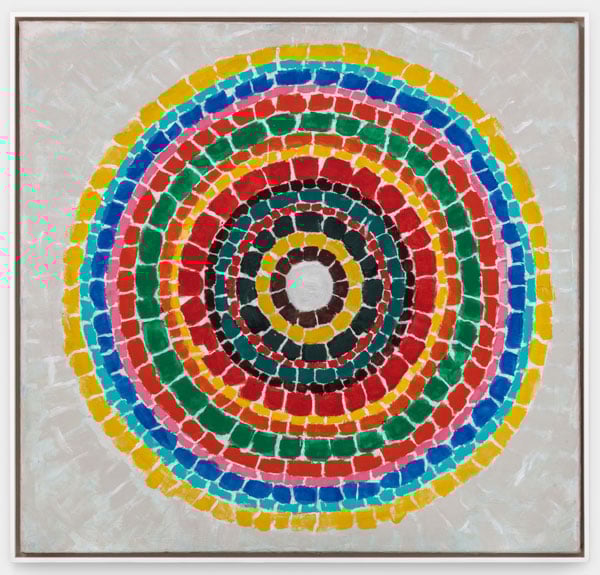
Alma Thomas, Untitled, c. 1968. (Joshua White / Estate of Alma Thomas / Artists Rights Society)
I sometimes daydream about which artists’ works I would buy if I hit the jackpot. It’s a pleasant distraction that often leads me to browsing online museum gift shops for T-shirts or tote bags bearing those artists’ works. As I type this, a paper doll likeness of iconic D.C. abstract painter Alma Thomas, a playful poster by Derrick Adams, and postcards of pieces by the late artist-activist Faith Ringgold, and text artist Glenn Ligon hang above me. Such purchases are probably the closest I’ll ever come to being a patron of the arts.
Then I look at Eileen Harris Norton and see she’s actually living the dream — and has been for nearly 50 years. A noted art collector, philanthropist, and lifelong Angeleno, Harris Norton has amassed an array of paintings, sculptures, photographs, and more by a laundry list of artistic legends. Though, to her credit, she frequently acquired their work before the artists became known names. Her covetable catalog seems like it was copy-pasted from a Contemporary Art History syllabus, with bullet points including Michelle Obama portraitist and one of Time’s 2026 Women of the Year, Amy Sherald; the various members of LA’s legendary Saar family (Alison, Lezley and Betye); and the matchless Kara Walker, whose most recent work reimagines an old Confederate statue for the blockbuster MONUMENTS.
Now, select pieces from Harris Norton’s collection have gone on view at Hauser & Wirth in downtown LA. Destiny Is a Rose — taken from the title of a Kerry James Marshall painting that’s featured in the show — displays more than 80 works that she’s hand-picked over the years. It’s what a private collection looks like when the patron has prioritized their own predilections and passions, no matter how idiosyncratic, rather than giving over to mere “trophyism” or clout-chasing.
 Kerry James Marshall, Destiny is a Rose," 1990. (Joshua White / Kerry James Marshall / David Zwirner)
The exhibition reflects Harris Norton’s attraction to art that examines African American history and culture, social justice, and feminism. While women artists (particularly African American ones) make up its core, the collection’s reach is broad and eclectic. There’s Fred Wilson’s glasswork, a parabolic lens by Fred Eversley, a Noah Davis painting depicting a vibrant slice of everyday life, and one of Patrick Martinez’s neon signs — all in just one of the gallery’s rooms. The subject matter swings from the objectification and policing of Black women’s bodies to LA’s homelessness epidemic to the water crisis in Flint, Michigan. But there is a dash of playfulness, too — in the form of a Yoshitomo Nara snowglobe or Takashi Murakami paintings of his signature character, Mr. DOB.
As writer Jonathan Griffin noted in a recent New York Times profile: “Her collection is backed up by abundant evidence of art by social connection, by care for a local community, and by personal history.”
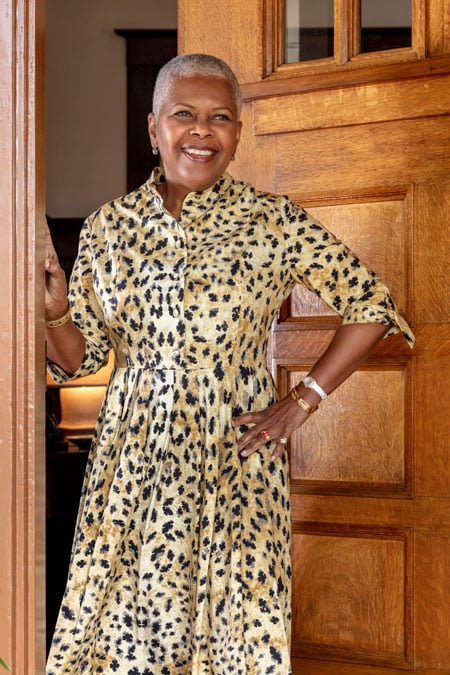
Eileen Harris Norton in Santa Monica in 2020. (Joshua White / Eileen Harris Norton Collection)
A native of Watts, Harris Norton grew up in a family with an abiding interest in the arts, and ultimately became an elementary school teacher. She unintentionally began collecting in 1976, when she bought a print from the influential LA printmaker and art historian Ruth Waddy, showing a group of people in a moment of excited exchange. (It is one of the first pieces visitors see upon entering the exhibition.) In the ‘80s, alongside her then-husband, software entrepreneur Peter Norton, she became a collecting force. The pair established a reputation for supporting underrepresented artists, which she continued to do after their 2000 divorce. She went on to co-found the South LA arts non-profit Art + Practice (A+P), and has sat on the boards of the Hammer Museum, the New Museum, and Harlem’s Studio Museum.
In interviews, she comes across as soft-spoken and modest, portraying herself as a school teacher who was simply fortunate enough to find herself in the position to acquire artworks. (Her backstory is strikingly similar to that of Shirley Kinsey, an L.A.-based former schoolteacher and art world outsider who — with her tech sector husband, Bernard — gradually amassed what is said to be one of the largest private collections of African American history and art.)
During a 2025 one-on-one with artist Mark Bradford, her friend and A+P co-founder, Harris Norton described her collection’s humble origins:
“Back in the day, you could see all the LA galleries in an afternoon. There were all these artists opening their doors. You’d see their art, and it was like, ‘Oh wow, look at that.’ We had no money to buy any art, but we enjoyed looking at the art and meeting some of the artists. Eventually, we could buy a little, and then it became a real thing.”
 Alison Saar, Bye Bye Blackbird, 1992. (Joshua White / Alison Saar / LA Louver)
Walking around Destiny Is a Rose, I was surrounded by so many of the artists whose works fill my own home — albeit in the form of coffee table books and framed prints. The outside-the-box thinkers, envelope-pushers, and kindred spirits fit together like puzzle pieces.
Having scrolled through digital tours of Harris Norton’s Santa Monica craftsman home in Architectural Digest and Wallpaper made this show feel all the more personal because the images showed how these pieces have been a part of her everyday life. What’s on display at Hauser & Wirth has rested atop her dining table, hung over her hearth, brightened up a bedroom, lined the walls of alcoves and hallways, and even stood on her lawn.
How gratifying to take in a celebration of this Black woman who, like me, hailed from a regular-degular, predominantly Black, middle-class environment, and had no formal art training or education, but made big waves in that sphere nonetheless. Observing the fruits of Harris Norton’s ongoing curiosity and boundless interests made me feel seen. If I ever do win the Powerball, she’ll be my blueprint.
🎨🎨🎨
Destiny is a Rose: The Eileen Harris Norton Collection is on view at Hauser & Wirth through August 16th; hauserwirth.com
Plus: See excerpts of Harris Norton’s conversation with Mark Bradford in this mini-doc from The Forgotten Her Story series.
Leigh-Ann Jackson is an art and culture writer whose work has appeared in the Los Angeles Times and The New York Times.
pages(slash)kcrw-app-campaign/Trustworthiness%20Banners/email(600x74).png?upscale=true&width=1200&upscale=true&name=email(600x74).png)