IMMERSION BLEND
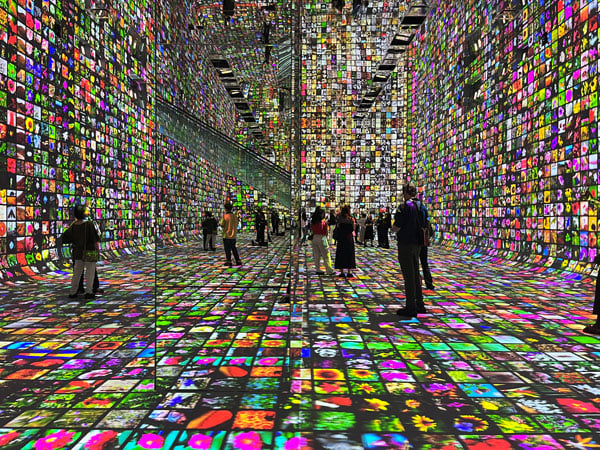
Dataland's Latent Forest space was inspired by rainforest ecosystems. (Carolina A. Miranda)
There’s a popular meme making its way through social media, taken from the Canadian children’s show, Nanalan’ that shows a character named Mona trying to feed her stuffed duck, Fleefer, some grape juice — which spills all over the place. The meme is often used to articulate the ways ideas are force-fed. One very popular version uses it as a metaphor for the ways in which companies have been ramming AI down the throats of … well, everyone.
On a visit to Dataland, “the world’s first Museum of AI Arts,” in downtown LA, I was feeling a bit like Fleefer. Founded by media artist Refik Anadol and his wife and partner, Efsun Erkiliç, the museum is set to open to the public on June 20th with an exhibition titled Machine Dreams: Rainforest, inspired by the couple’s experiences in the Amazon. The “omni-sensory” show occupies the entirety of the 25,000-square-foot space and features immersive digital visualizations, scent components, and interactive experiences. It even engages taste. (AKA, you get chocolate).
Dataland is one of two new family-friendly artistic experiences in LA currently vying for your attention and your wallet. (Dataland’s adult admission starts at a handsome $49–79.) On the other side of the 110 Freeway, you’ll find Hospital of Emotions, a temporary group exhibition inside the now-defunct St. Vincent Medical Center off of Alvarado Street. Organized by curator Yaara Sachs of the pop-up company House of Art & Dreams, the show reimagines four floors of the old hospital — which will soon be turned into a services campus for the unhoused — with 80 interventions inspired by emotions such as sadness and joy. (Standard adult admission: $55.)
 At the Hospital of Emotions, you'll find an installation of a cardboard forest by Greg Corbino.
(Carolina A. Miranda)
I’ll start with Dataland. Before digging in, I want to note that I am not reflexively against artists using digital tools or AI. One of the most wrenching art experiences I’ve ever had — digital or otherwise — was playing artist Natalie Bookchin’s devastating video game The Intruder (1999), inspired by a short story written by Jorge Luis Borges. But digital tools on their own do not meaning make.
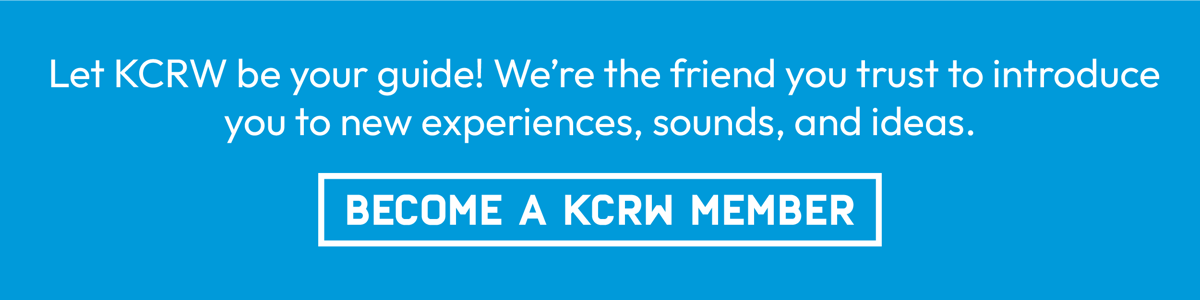
Dataland consists of a sequence of galleries featuring elaborate visualizations of ecological data from rainforests around the world, taken from Anadol’s “Large Nature Model,” an open-access AI program based on nature data. In the first space, I was blasted with abstract streaks of color, collages of flowers, cosmic arrays of molecule-like blobs, depictions of forests — all highly Instagrammable. Some of the projections are responsive, mirroring the form of your body as you move around the space. Others harvest information from the visitor to form the experience.
Upon entering the museum, we were all given bracelets that monitored our biometrics, as well as a collar that produced individual nature-inspired scents based on our vitals. The collar gassed me with what smelled like a floral room deodorizer. (I took it off or I would have ended up with a migraine.) And, at one point, I saw my heart rate projected onto the floor by my feet (which felt weirdly violating). The aesthetic purpose of all this? The only answer I can conjure is that it’s because the artists could, not because they should.
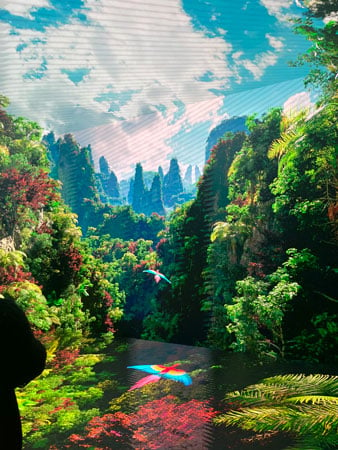
A film in Dataland's Infinity Room was inspired by rainforest myth and ecology. (Carolina A. Miranda)
The central piece at Dataland is an AI-generated film, The Dream of Ruwe Pinu, displayed in a space called the Infinity Room, a cube-shaped gallery lined with LED video panels on all sides, including underfoot. Being surrounded by video can feel destabilizing (in an intriguing way), but the film itself is narratively thin. It is inspired by a dream that Anadol had of a hummingbird and concludes with a text about the last Kaua‘i ‘ō ‘ō bird in Hawaii searching in vain for a mate. You’ll see a digitally-rendered translucent hummingbird, verdant valleys, and sparkling streams rendered in the style of a high-definition video game. There are also more abstracted flurries of color.
The short reference to the Kaua‘i ‘ō ‘ō bird was perhaps the one poignant moment in Dataland. The intention of the show appears to be to make the viewer part of a rainforest environment, but instead it came across as a pyrotechnics of programming. With its long list of sponsors, including Nvidia, Google Cloud, Epson, and LG Electronics, the show is more like an immersive ad for AI-powered data visualization — we are all Fleefer! — than a sincere exploration of humanity's troubled relationship to nature. My advice: pick up a copy of Adrian Forsyth and Ken Miyata’s brilliant and moving book, Tropical Nature, instead.
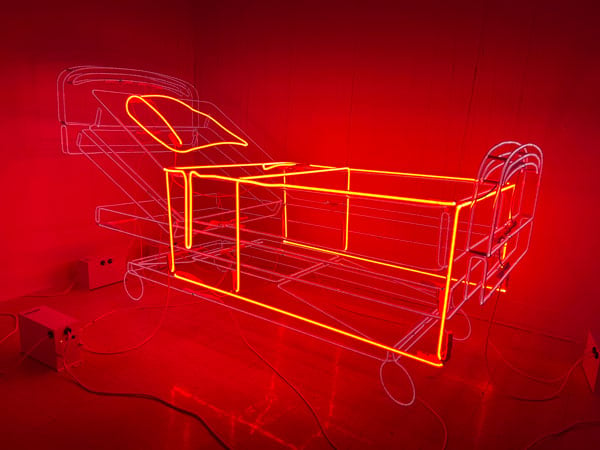
At the Hospital of Emotions, artist David Otis Johnson crafted a hospital bed out of neon. (Carolina A. Miranda)
Prior to seeing Dataland, I’d made a trip to see the Hospital of Emotions in Westlake. I did so with some skepticism, since I am generally allergic to pricey immersive experiences. But the hospital is the better bet — partly because it’s fun to explore the nooks and crannies of a decommissioned building. The work can be uneven, and yes, there are plenty of Instagrammable installations. (Queue a room brimming with stuffed animals.) But I was struck by the inventiveness of some of the interventions, which were devised with comparatively modest budgets.
A room by David Otis Johnson features a hospital bed sculpted out of neon that materializes like an apparition. Another, by New York-based designer Greg Corbino contains a charming forest cleverly crafted from cardboard. Interdisciplinary artists Anna Matsumoto and Bhumikorn (“Bhu”) Kongtaveelert took medical devices they found onsite and wove them together with strands of flickering red lights. Stepping into the room is like entering a pulsing circulatory system.
Collectively, the works bring wild splashes of color and form to a type of architecture that too often goes without. I spend a lot of time in hospitals. (I help care for a severely disabled sister.) And I like to joke that navigating the average hospital corridor offers all the aesthetic joy of being the camera in a colonoscopy. Hospital of Emotions had me thinking that communities should be inviting artists to participate during the design phase of hospital construction, rather than after they shut down. It’s amazing the wonder you can create with a little bit of cardboard and paint.
🏥🏥🏥
Hospital of Emotions is on view at 2131 W. 3rd St (the old St. Vincent’s) through July 31st; hospitalofemotions.com.
Dataland opens on June 20th with the exhibition Machine Dreams: Rainforest, on view through January 31st; dataland.art.