Love is the Message
You may not have heard of a short, experimental film by Ben Caldwell called I & I: An African Allegory. Until relatively recently, neither had I. But you’ve probably seen echoes of its formal qualities in the heart-pounding supercuts of the inventive Arthur Jafa (whose work straddles fine art and film) and in the dreamy scenes of Black women as imagined by filmmaker Julie Dash (whose influence can be felt in videos by contemporary pop stars like Beyoncé).
I & I is one of several films by Caldwell that are screening as part of his solo exhibition, Kaos Theory: The Afrokosmic Media Arts of Ben Caldwell, currently on view through March 8th at Art + Practice in Leimert Park. And it couldn’t be more resonant.

Pamela Jones as Alefi in I & I. (Ben Caldwell)
Completed in 1977 as part of his graduate film studies at UCLA, I & I is a small but powerful film. Just half an hour long, it has no linear plot; instead, the film plunges the viewer into imagery that reflects on concepts of reciprocity and the Black condition in the United States. Pamela Jones plays Alefi, a human incarnation of a Yoruba wind spirit, who bears witness to hundreds of years of African American history. Some of this is presented in a straightforward way. A documentary-style scene features a Black elder recounting how her father was brutally attacked for trying to vote. Other elements are more abstract: African American history is rendered via a supercut of still images set to thrumming music.
Towards the end of the film, Alefi cradles her son and tells him, “We have to submit to each other, look after each other, respect each other, and love each other.”
The film was informed by the Rastafarian concept of “I and I,” which doesn’t differentiate between a “you” and “I,” but instead sees every person as part of a greater collective consciousness. It’s a worldview shared by other cultures, too.
Caldwell created the piece after returning from a tour of duty in Vietnam, where he faced the dehumanizing horrors of war. “I also got to see in the war zone that there were real humans there,” he told an oral historian from the Library of Congress in 2013. “And we were only able to kill them because we made them the ‘other.’ And I saw a lot of similarities with the ‘other’ in me. I was the ‘other’ in the United States.”

Ben Caldwell on a shoot in the 1980s. (Courtesy Ben Caldwell)
Caldwell is part of a generation of Black filmmakers known as the “L.A. Rebellion” that emerged out of UCLA starting in the 1970s and sought to create films that pushed the boundaries of the form while countering Hollywood’s blinkered vision of Black life. (He is also known locally as the founder of KAOS Network, a media lab and creative space for young people in Leimert Park.)
I and I, says exhibition co-curator Robeson Taj Frazier, is reflective of the highly experimental approaches of the L.A. Rebellion. “Ben was invested in cultivating a unique editing approach that was a bit more rhythmic and a bit percussive,” he says. “He was also invested in what kinds of feelings and emotions an image can create, how one image juxtaposed along another image, what that might induce in the viewer.”
Frazier is the co-author, with Caldwell, of the terrific 2023 book, Kaos Theory: The Afro-Kosmic Ark of Ben Caldwell (Angel City Press), which recounts Caldwell’s life and work. The book features a poignant introduction by Jafa, whose searing 2016 video montage, “Love is the Message, The Message is Death,” mixed original and found footage to articulate a story about Black life within the systemic racism of U.S. society. (It was on view at the Museum of Contemporary Art Los Angeles for several months in 2017.)
Jafa, who studied under Caldwell, and whose work is in conversation with that of his mentor, writes that seeing I and I for the first time was “like being struck by lightning.” It was, he adds, “fully realized jazz cinema.” I’d add that Caldwell’s film belongs in museum collections — namely, MOCA, which also holds Jafa’s work.
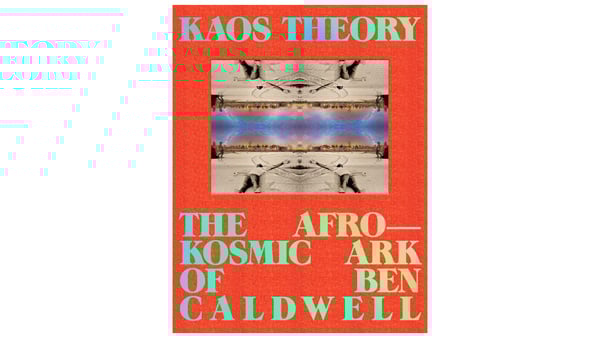
Published in 2023, Kaos Theory brings together Caldwell's life story and artistic vision. (Angel City Press)
I and I is not available to stream and it’s not on YouTube, which is why it’s special to be able to walk into Art + Practice to watch it. (It plays on a loop with several other short films by Caldwell.) This is an important film. And at a moment of political fracture — in which the boundaries between “you” and “I” seem to grow ever harder — its themes couldn’t be more meaningful.
Kaos Theory is on view at Art + Practice through March 8th. On February 12th, Caldwell and Jafa will be in conversation at the space. Get the details at artandpractice.org.
Three more films
Get into the Black avant-garde with three other films. Frazier recommends:
Water Ritual 1: An Urban Rite of Purification (1979), by Barbara McCullough. Caldwell served as cinematographer on this experimental short film about ritual that was shot in a part of Watts that had been razed to make way for the 105 Freeway. The film is not currently streaming but regularly emerges as part of film festivals and events staged by the UCLA Library Film & Television Archive.
Daughters of the Dust (1991), by Julie Dash: This hypnotic feature film explores the intergenerational struggles of a Gullah family from the sea islands of Georgia at the turn of the 20th century. It is available to stream on various platforms, including Criterion.
If I Go Will They Miss Me? (2022), by Walter Thompson-Hernández. A contemporary short film by the LA journalist employs fictional characters to tell a story about environmental racism in Southeast Los Angeles. It's not currently streaming, but keep an eye on Cartel.tv, the website of the film’s production company for updates, or follow them on Instagram.


%20loveletters/email(600x74).png?upscale=true&width=1200&upscale=true&name=email(600x74).png "An ad banner reads: \"Love Letters to LA — Learn More\"")
.png?upscale=true&width=1200&upscale=true&name=email(600x74).png "A sweepstakes ad banner reads: See the World in 2025!")

(at%20symbol)TheSamSandersShow/Watch_email(600x74).png?upscale=true&width=1200&upscale=true&name=Watch_email(600x74).png "Watch_email(600x74)")