GAME ON
by Joanne McNeil

asses.masses is a hybrid video game/performance told through donkeys. (Patrick Blenkarn and Milton Lim)
How long does a performance have to be for its duration to engulf conversations about it? Even when the work involves a video game about “unemployed donkeys,” which the audience performs as collective, and, as the website warns, includes “simulated sex between donkeys” (which means it’s probably not suitable for kids).
In the case of asses.massses: seven hours.
And that’s just a rough estimate. The performance by Canadian artists Patrick Blenkarn and Milton Lim, playing at the Center for the Art of Performance at UCLA this Saturday, could go even longer. This hefty time commitment — approximately a full work day — hasn’t detracted curious theater-goers. The show has played to packed houses from Buenos Aires to Singapore since its workshop premiere in 2018 at the Shadbolt Centre for the Arts in British Columbia.
At the heart of the show is a custom video game set in a postindustrial landscape in which a pack of donkeys come together to demand that humans cast aside their machines and give them their old jobs back. Levels (which asses.masses refers to as “episodes” as a nod to binge watching) span throwback elements from rhythm game challenges to retro arcade shooters, suggesting a history of the Luddite movement as told by Donkey Kong. Over the course of the show, players — that’d be volunteers from the audience — take on the narrative themes of organized labor and resistance as the theater itself becomes a site for collective action.
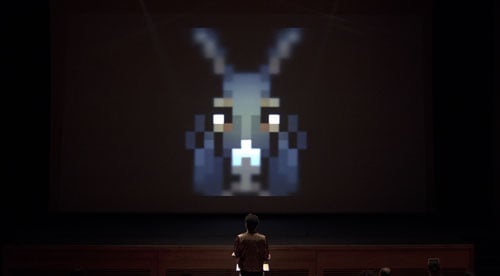
An audience member takes on asses.masses in 2023. (Francisco Castro Pizzo)
Lim and Blenkarn met at the School for the Contemporary Arts at Simon Fraser University in Vancouver, where Lim had been working and Blenkarn was a grad student. There, they bonded over a shared interest in “doing things inside of theaters that didn't typically happen there,” Blenkarn said.
An earlier collaboration, culturecapital, consisted of a participatory card game-based performance about working in the arts. asses.masses likewise relies on its audience, but as Edgar Miramontes, the executive and artistic director of CAP UCLA, is quick to point out, the artists are also reimagining what “participation” means in theater. You don’t have to worry about being someone in the audience “pulled up on stage,” he said. Miramontes, who first saw the show at the Festival TransAmériques in Montreal two years ago, insists there’s no cringy crowd work in asses.masses. He programmed the show at the Nimoy Theater because, as playful as it is in turns, there’s a “humanity to it.”
Since the performance was announced, people have had questions about its runtime. Someone even asked Miramontes, “Should I bring a book?” He’s confident that attendees of the performance, which has already sold out with a growing wait list, will be surprised at how invested they become in the experience.
That investment — and the time commitment — is something Lim and Blenkarn have ported from video games to the stage. The artists are fascinated by how time tends to be elastic in games, generating a permissiveness and spontaneity that they see as lacking in contemporary theater. In culturecapital, Lim and Blenkarn puzzled theatrical presenters when they said the shows could be thirty minutes or three hours. “It felt a lot more alive,” Blekarn said, to untether the performance from a strict run time. The length of the asses.masses, like a game, depends on how the audience plays it.
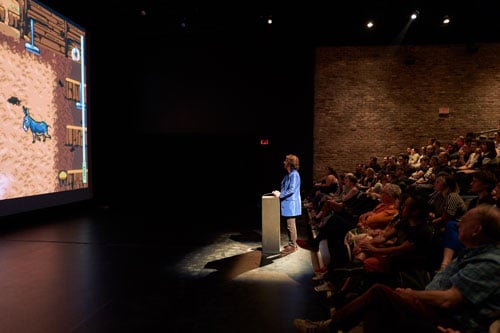
Its length hasn't stopped asses.masses from being popular with audiences. (Vivien Gaumond)
Games can also be social experiences. You might watch someone streaming on Twitch or pass the controller around at a party in someone’s living room. asses.masses expands that experience to a 254-seat theater. The duo, along with producer and dramaturge, Laurel Green, and composer and sound designer, David Mesiha, have traveled the world with asses.massses. At least two members of the team act as show operators on site at each performance, hosting and managing the game’s computer. Food is served — a “delicious combo of healthy and junk food” according to the website, with options for vegans and vegetarians. And breaks are taken as liberally as the audience decides to take them.
Ultimately, Lim and Blenkarn hope to subvert the typical way people attend theater: they show up and then go home. As Lim put it, asses.masses is a way to give the audience a voice inside the theater “instead of just sitting in the dark by themselves, besides strangers.”
It’s an ambitious goal to weave the experience of the work from the stage through the seats. But Kendra Albert, a friend of mine who caught the show at the Philadelphia Fringe Festival last September, confirms that the experience of asses.masses stayed with them. As a theater enthusiast who plays a lot of video games, the listing had them intrigued. Expecting to cut out early, Albert instead stayed to the end, which, as they recall, was closer to 10 hours all told. At the Philadelphia show, audience members took on characters and did voices for them.
At a recent convention in Washington, DC, Albert saw someone who looked familiar. They asked the guy, “Were you at asses.masses?” Right there, the fellow attendee performed the high-pitched goofy character voice he had taken in the show. A connection had been made, after all.
🐴🐴🐴
Patrick Blenkarn and Milton Lim’s asses.masses will be on stage at CAP UCLA’s Nimoy Theater on February 7h at 1 PM; cap.uca.edu.
Joanne McNeil is an author and critic based in LA.
.png?upscale=true&width=1200&upscale=true&name=email(600x74).png)