DOG DAYS
by Paula Mejía
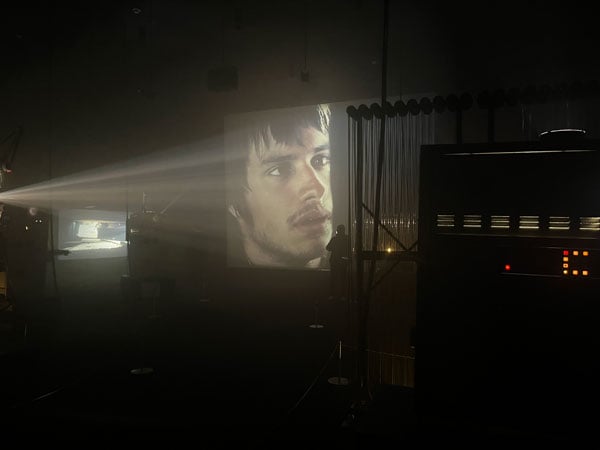
An installation view of Sueño Perro at LACMA. (Carolina A. Miranda)
To enter Sueño Perro, a film installation currently on view at the Los Angeles County Museum of Art (LACMA), visitors first peel back a heavy curtain. One is soon enveloped by a darkness so total that docents illuminate the way forward with flashlights. Yet that moment of sensory deprivation is brief; inside the gallery, an industrial cacophony awaits. Six hulking analog projectors whir and groan, beaming celluloid film images onto the walls, complete with scratches, blurs, and other marks of human imperfection. Tunnels of light, illuminated by a water-based smoke purposefully pumped into the room, criss-cross the space.
High-contrasting frames run alongside one another, making it tough to train one’s attention on a single screen at a time. Though, often, these feature the same precipitous event: a tough-to-stomach underground dog fight in Mexico City that catalyzes a head-on car crash, rendered from a multitude of camera angles as the intermittent sounds of crushing metal jolt the room. The whiplash effect is intentional. The exhibition's theatricality acts as a vessel for the avant-garde installation itself and a framework to reconsider its progenitor, Alejandro González Iñárritu’s groundbreaking debut feature film, Amores Perros.
Timed to the 25th anniversary of its initial release, LACMA’s display features unseen outtakes from the one million feet of film that Iñárritu shot before whittling Amores Perros down to a less daunting 13,400 feet. (The final cut is a touch over two and a half hours long.) Ordinarily, the extra footage would be tossed out, but his producers instead housed them at the archives at the National Autonomous University of Mexico (UNAM). When Iñárritu got wind that the outtakes of Amores Perros were still available, he became intrigued by the idea that different films existed within the creation of the original. He then spent several “liberating and melancholic” years delving into the unused cuts, driven by the feeling that this new project could exist outside of the movie it eventually became — in which he was "not being subordinate to narrative,” as he told KCRW during a recent press preview. The resulting installation, he said, is akin to sharing his “dirty laundry.”

Extra footage from Amores Perros spent roughly two decades in a university archive in Mexico City.
(Karol Pruzinksy)
This is not Iñárritu’s first go-around forging experimental works for LACMA. Nearly a decade ago, he created Carne y Arena, a searing virtual-reality piece that took visitors through the forbidding trajectory that immigrants make while crossing the U.S.-Mexico border, which included a room mimicking a frigid detention center cell. While vastly different in scope and execution, Sueño Perro traces a similar through-line in how the director uses multisensory technology to craft an unrelenting experience. Existing as its own work and an accompaniment to Amores Perros, Sueño Perro animates the myriad consequential decisions filmmakers make, highlighting repeated scenes played in slightly different ways by actors, and the deeply saturated visual language that helped make it a surprise hit upon its 2000 release.
Amores Perros braids together three separate narratives of people undone by a car collision. Told in a nonlinear manner, the stark depictions of fraught relationships — as well as a Mexico City shot in tight quarters, sans architectural icons and other hallmarks of the city’s beauty — earned the movie several honors at Cannes, a BAFTA, and an Academy Award nomination for Best Foreign Language Film. Besides catapulting Iñárritu, an ex-radio DJ, into filmmaking stardom (as well as one of its stars, a little-known former child actor named Gael García Bernal), the success of Amores Perros became an inflection point in the then-burgeoning Nuevo Cine Mexicano movement. Beginning in the 1990s, a new generation of rising Mexican filmmakers, including Iñárritu, Guillermo del Toro, and Alfonso Cuarón, meditated on class tensions, labor, violence, family dynamics, and sex in fresh ways onscreen. Their dramatic works gave way to a surge of creative momentum the country hadn’t seen since the Golden Age of Mexican Cinema in the first half of the 20th century.

Filmmaker Alejandro Iñárritu, left, and LACMA director Michael Govan at the preview for Sueño Perro.
(Carolina A. Miranda)
When Iñárritu and his contemporaries started out, opportunities were slim even for established figures. But Amores Perros was financed privately, a break from the typical government-funded filmmaking that defined Mexican cinema at the time. “These resources helped enable the producers and the director to cater to a new audience, one that had been overlooked by recent Mexican filmmaking,” notes Fernanda Solórzano, writing for the Criterion Collection, which released a restoration several years ago. “This audience was younger and, most notably, had been exposed to more Hollywood films than previous generations.”
A quarter-century after its premiere, Amores Perros still feels shocking in its realism and brutality to watch. The film’s anniversary notwithstanding, the timing of the LACMA exhibition has an urgency to it, given Hollywood’s ongoing crisis — exacerbated by political machinations, economic struggles, and labor concerns around AI that threaten to contract a beleaguered industry even further. As the industry relies further on safe bets to shore up box office profits, a show like Sueño Perro, which the director has described as “a statement against AI,” underscores what history has long shown: That a lack of resources and institutional support hardly stops scrappy artists from creating lasting, idiosyncratic works.
📽️📽️📽️
Sueño Perro: A Film Installation by Alejandro G. Iñárritu is on view at LACMA through July 26th; lacma.org.
Paula Mejía is a culture writer and editor based in LA. Her work has appeared in the New Yorker, Texas Monthly, The Atlantic, and GQ.
This story includes reporting by Carolina A. Miranda.
piefest/email(600x100).png?upscale=true&width=1200&upscale=true&name=email(600x100).png)