TRIAL BY FIRE
by Paula Mejía
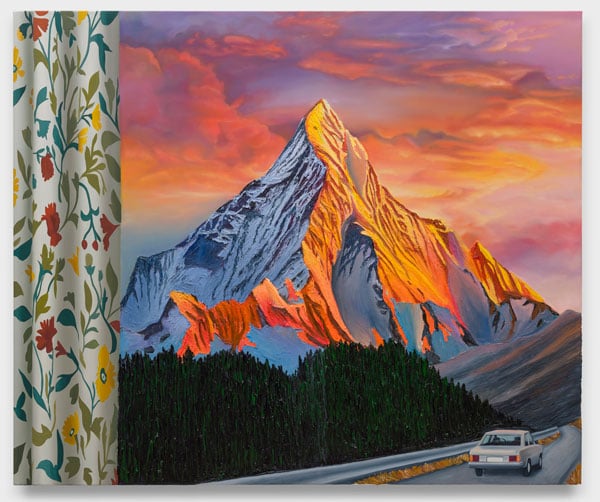
Alec Egan, Sunset Mountain, 2026. (Jeff McLane / Vielmetter Los Angeles)
In early January 2025, the Los Angeles-based artist Alec Egan was close to completing a decade-long endeavor: Painting an imagined home, room by room. He didn’t rush the process. At his solo gallery shows over the years, Egan would display meticulous, large-scale studies of a single room within this fictional home he was building. Each space often burst with a glorious cacophony of floral motifs — with blooms festooned on wallpaper, florid-patterned couches, and sometimes displayed in a vase. To round out the series, Egan spent two years working on roughly 25 impasto paintings that included the last rooms in this fictional house — a kitchen and a bedroom.
As Egan chipped away at these final paintings, a wildfire ripped through the Palisades, the site of his own longtime home and studio space. The morning that the Palisades Fire burned through the region, Egan and his family evacuated. Egan’s art installer later rushed over to try to salvage the paintings, but the street had been blocked off as crews worked to extinguish the flames. A few days later, Egan returned to find his home and studio, and everything in it, charred down to the studs. Speaking over Zoom nearly a year and a half later, Egan says that he was not thinking of his lost work in the immediacy of the blaze; what mattered was that he and his family were thankfully safe. But in the devastating aftermath, the artist felt an instinctual pull to document the surreality of what he’d survived.
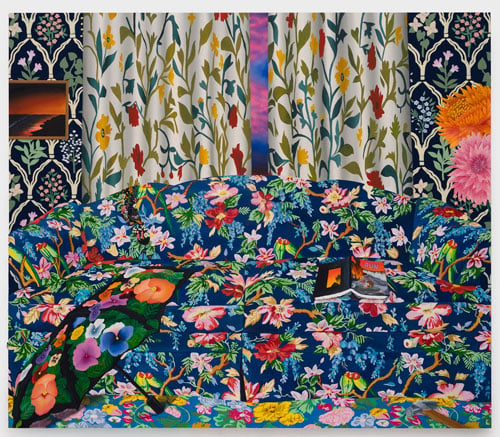
Alex Egan, Front Room, 2026. (Jeff McLane / Vielmetter Los Angeles)
He had a brush in his hand mere weeks later. “It was art as journalism: ‘I gotta paint the fire. I am implicated in this historical, tragic event,’” he says. “I wasn't consciously thinking this, but it's like, my responsibility. Both for myself to heal, and just paint what we fucking saw here as a city.” Egan then spent the next few months painting at a prolific clip, imbuing his terror-stricken awe of this natural disaster into his paintings. “I know I'm about to lose everything, but I've never seen anything like this: The scale of nature at its height, devouring the things that we put so much value on, easily,” he remembers thinking. “It was displacing, in one way — in a material, human, societal way. But very recentering in an animal way.”
A baker’s dozen paintings that Egan forged during this liminal period are now on view at his solo show, Groundskeeper, at Vielmetter Los Angeles in downtown — his debut for the gallery and his first solo offering in the city since the fire. The painter’s familiar emphasis on clashing patterns, prismatic color, and textured finishes have not changed. Florals still abound. But Groundskeeper bears a darker and more self-referential tone than Egan’s past exhibitions. The grave nature of these paintings, he explains, “allows its humor and its psychological overwhelm through the patterns and the layering of paint to be a little bit more meaningful.”
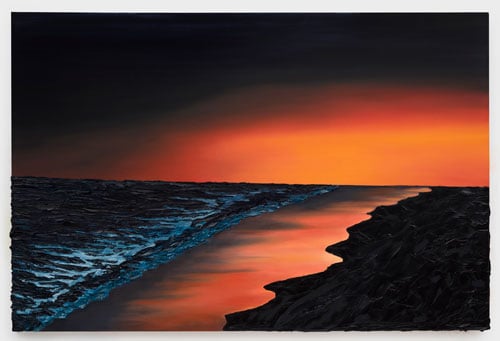
Alec Egan, Night Beach, 2026. (Jeff McLane / Vielmetter Los Angeles)
Destruction’s propensity for fueling both brutality and beauty factors significantly into the show. A piece titled Night House features Egan’s usual domestic motif, set against a streaky pink and blue sky — showing the staggering drama of LA at dusk. Nearby, another painting, Night Beach, sees a sandy shoreline moments away from being swallowed by a deep orange sunset, as rich and thick as marmalade. These pictures become less pretty, though, when one considers where these vivid hues are coming from: Could it be from air pollutants, which make sunsets appear more orangey in hue? Is the sky tinged with these distinctive colors due to ash from a nearby wildfire, or is it just a usual sundown?
The show viscerally probes calamity through an eponymous work showing a groundskeeper — one who closely resembles Egan — sitting beside a citrus tree. The plant’s branches are wrapped in thick netting, which helps protect newer trees and acts as preemptive bracing for inclement weather; the groundskeeper is likewise swaddled in a floral-patterned blanket. The man appears to be looking out into the distance as an ominous sun sets behind him. It’s a close read of an environment gripped by disaster as well as “what it takes to live in this environment imaginatively,” as Egan puts it.
Despite the doom closing in on him, the groundskeeper appears incapable of rousing himself from this daze. For Egan, the groundskeeper’s inability to act comprises a core ethos of the show: In our "prodromal world,” he says, referring to the symptoms that precede illness, “everything is reaching this crescendo of overwhelm, where you're activated to maybe do something, but you're also completely in stasis.” Egan does not feel stuck in the limbo of inaction, at least where this particular show is concerned. “When people have been asking me about how I feel about the show, I feel like I could have done nothing more,” he says. “And that feeling I rarely have as an artist.”
🔥🔥🔥
Alec Egan, Groundskeeper, is on view at Vielmetter Los Angeles through May 16th; vielmetter.com.
Paula Mejía is a culture writer and editor based in LA. Her work has appeared in The New Yorker, Texas Monthly, The Atlantic, and GQ.
.png?upscale=true&width=1200&upscale=true&name=email(600x74).png)